Wednesday, December 21, 2016

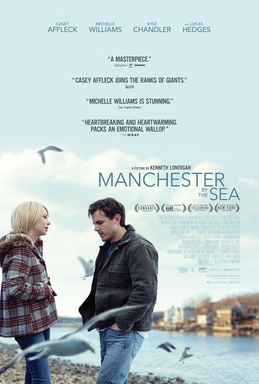
Manchester by the Sea


Score:  ***** out of ***** (A+)

Directed by Kenneth Lonergan
Starring Casey Affleck, Lucas Hedges, Michelle Williams, Kyle Chandler
Running time: 137 minutes
Rated R

Long Story Short:  Manchester by the Sea is a quiet, simple drama on the outside, and a tumultuous and affecting one on the inside.  It's also one of the best films I've ever seen.  Casey Affleck leads a set of brilliant performances as the film takes a deep, sometimes painful but always revelatory, dive into his character.  Amazing writing and filmmaking turn ordinary people and events into both a moving and thought-provoking experience.  A must-see.


Lee Chandler (Affleck) lives a lonely existence as a janitor in Boston.  Forced to deal with abrasive tenants in an apartment, Lee's patience is often tested and he frequents a bar to cope.  One day, his routine is abruptly interrupted when he receives a call that his brother (Chandler) suffered a heart attack.  Lee rushes to him, but by the time he arrives his brother is dead.  Left behind is his sixteen-year-old son, Patrick, and Lee is shocked to learn that he is to become the young boy's guardian, according to his brother's will.  Once close, Lee and Patrick are now tense in each other's presence; Patrick dealing with school, girlfriends and a band, and Lee trying to sort out his brother's affairs and coping with his past.  One missing a father, the other his brother, the two must relearn how to live, together.

Manchester by the Sea boasts an ensemble that works so well, both individually and as a group, that it is easy to forget that they are acting.  Casey Affleck delivers an incredibly powerful, nuanced and memorable performance as the quiet and tormented lead, Lee.  The camera follows Lee throughout the film, and mostly his misery is internal, seen through his gaze and his weary but persistent march through life's everyday challenges.  Affleck brings Lee to life as fully as any film character I've ever seen.  Like any human, he sometimes responds awkwardly to others, makes odd decisions, and grits his teeth and bears life's annoyances; and he is also sympathetic, a good man trying to find his way after losing it years ago, though often conflicted about whether he should even try.  Lucas Hedges does a great job as teenage Patrick, simultaneously aware of the adult challenges of his situation while showing the pain of the loss of his father as he experiences both setbacks and joy in other roles.  Michelle Williams' screentime is fairly limited, but she makes the most of it as Lee's ex-wife by bringing startling detail and individuality to a character that could have merely been a powerful symbol of Lee's old life.  Kyle Chandler is in the final significant role, as Lee's brother Joe in flashbacks; although we don't get to know him, he excels at portraying the pillar of emotional stability in the family, without which we can see (partly) how things have fallen apart.

Manchester by the Sea is an incredible film, the drama of a simple story of ordinary humans, but the film delves deeply - and movingly - in and through those people.  The main plot event, Joe's death, is front and center, yet the film's most powerful event is one from the past and in more subtle ways it affects everything and everyone in the film just as much.  I won't reveal what that is (and please don't go look it up!), but it is a symbol of the way the film overall works not through direct events but through individual responses and relationships.  Manchester confounds expectations everywhere; it is deeply affecting and emotional, yet by the end neither depressing nor uplifting but simply life affirming.  It is not Hollywood drama in any way, yet not minimalistic (read: boring), either.  Though there are a few incredibly emotional scenes (especially the one above), you can regain an emotional equilibrium afterward.  The film has no jokes, and of course is quite serious, yet it finds humor consistently and effectively through the little things in life.  The film ends with the characters having made progress and there is hope, yet it is not at all tied up with a bow; it resists expected resolution and not everything works out the way you think it will or want it to.

How does Manchester by the Sea achieve such balance and power while relying on simple components (characters, plot, setting)?  The acting described above is of course an essential part, and just as important is a phenomenal script which, combined with the performances, creates one of the most vivid worlds I've every seen on film.  The plot - Joe's death, and what that sets in motion - is only the canvas of this work; it is the characters and their relationships that are the "action".  The pacing, in a conventional sense, is therefore deliberate (some would say slow), yet it is the characters driving the pace, not the events.  Everyday life makes up most of the scenes, particularly that of Lee adjusting into his old hometown, Patrick struggling with adolescence, and the two attempting to bond (or at least put up with each other).  Each scene shows one (or usually several) of the following: another side of a richly shaded character; a small (yet important) thing that causes them to change; and/or something amusing.  This allows us to know the characters as few other films can do, increasing the impact of all that happens to them, from the small to the large.  We genuinely root for them, want the best for them, because we see some of ourselves in them.

***

Manchester by the Sea is one of the best films I've ever seen, period, and is therefore one of the few films that I've give an A+ to outright.  I admit that when I first heard about this film and read the premise, I was unimpressed.  But I read (while trying to avoid too much detail) that it was outstanding, and I try to see most films that get praise like that.  Fortunately for me, my rural theater happened to show it.  This is a film that had me thinking about it the rest of that night and the next morning.  The performances, writing, and filmmaking in general are masterful.  And there's plenty you can take away from it, both specific to the type of tragedy it illustrates as well as to life's struggles and changes in general.  I'm not sure what more I need to say about it here, though it's also a film that I could talk about all day.  Manchester by the Sea is a must-see classic.


By Source (WP:NFCC#4), Fair use, https://en.wikipedia.org/w/index.php?curid=51487176

Saturday, November 19, 2016

Arrival


Score:  **** out of ***** (A-)

Directed by Denis Villeneuve
Starring Amy Adams, Jeremy Renner, Forest Whitaker
Running time: 116 minutes
Rated PG-13

Long Story Short:  Arrival is another alien encounter sci-fi film, but not at all what you're expecting.  Denis Villeneuve, having shown so much skill with both tension and personal challenge in previous films, is the perfect filmmaker for this ostensibly much different story.  With Amy Adams leading the drama in a strong performance, the film is more concerned with what alien contact might mean for humanity beyond just who blows up who.


In the span of a few minutes, the life of a young girl with her mother, Louise (Adams), unfolds and is tragically cut short by illness.  Louise, a linguist, teaches at a university when normal life is abruptly interrupted by the appearance of twelve alien craft, spread around the world.  The military, led by Col. Weber, soon comes to Louise in hopes of finding a way to communicate with the alien visitors.  Intrigued, Louise agrees and goes with them to Montana, where she meets the team including physicist Ian (Renner).  Operating from a small make-shift base, the team goes into the alien ship.  They encounter two individuals who make odd, indecipherable noises.  Although she is overwhelmed by them at first, Louise remains determined, and becomes convinced that written communication is mankind's best hope of understanding the aliens.

While Louise and Ian became fascinated by the intellectual process of understanding the aliens, their military commanders pressure them to work faster and faster.  Society begins to crumble under the stress of the alien presence, and other nations faced with alien ships in their territory also begin to lose patience.  Resting on Louise's shoulders, then, may be the fate of civilization itself.

Arrival operates with a small cast, and focuses even more narrowly on its lead.  Amy Adams takes on that lead role as Louise, and she is tremendous.  Of course, Adams has proven herself one of today's top actors already and she readily takes on this complex - and not particularly sci-fi-y - role.  She brings Louise to life, a woman more comfortable as a curious, highly intelligent academic woman than her personal side which she keeps to herself.  Louise first develops a professional rapport with Ian, only slowly becoming closer on a personal level as they are confined together on the base.  Encouragingly, Louise remains not only the more active but also the primary character in the film, not giving way to Ian.  Personal stakes do eventually come into play for Louise, and Adams handles them in a way appropriate for the character (i.e. controlled), rather than succumbing to Hollywood norms.  Jeremy Renner is also very good, perhaps for his restraint more than anything else.  Optimistic, though not cheerful, Ian is a team player who does not try to become the star of the show, offering crucial support for the lonely and stressed Louise.  Beyond Louise and Ian, the roles are few and small; Whitaker's Weber is torn between support for Louise and military duty to achieve its objectives as quickly as possible; and Michael Stuhlbarg is a sarcastic agent focused on America's coming out on top in the situation, regardless of the consequences.

Arrival is a brand-new flavor of sci-fi film, one that is flawed yet powerful and represents great hope as a melding of popular and artistic styles.  Like Christopher Nolan's Interstellar (more comparisons to this to come), Arrival is not a simple us-vs.-them shoot out.  There is plenty of tension, yes, but both films' primary mission is to engage your mind by using the tangible strangeness of sci-fi to look inward at humanity and the self.  Again, Arrival shares similar themes to the Nolan film: both the importance and lack thereof of time, and the need to put aside societal differences to advance the common causes (or to prevent the common destruction) of humanity.  A new element is that of communication and language, which plays into both of the others.  The details still demand a certain suspension of disbelief, of course, but I would argue it's the concepts that count.  The emotional elements are much more restrained in Arrival, but the main twist is fascinating (**highlight the blank area after this if you want to read spoilers**).  Louise's flash-forwarding to her daughter's life is both ingenious and heartbreaking.  I personally feel it actually could have been made even more affecting, with a tweaking of other elements in the film, but opinions on this will vary.

Fear not, Arrival is not just some abstract examination of ideas (Tree of Life this is not, thankfully).  The build up to the aliens in the first third or so of the film is riveting, and most reminiscent of the director Villeneuve's other work.  It's all quiet and very real, given just enough information and atmosphere (empty seminar rooms, roaring jet engines) to feel something big coming - not to mention a very eerie and affecting soundtrack.  Getting suited up to go into the alien ship, Adams breathes hard and noisily, echoing the audience's feelings.  Then the film admittedly bogs down a bit; there's only so much you can do to enliven the process of essentially language translation, I suppose.  But there is constant pressure to the intellectual work being done, with occasional news footage of rioting and tension among nations shown.  The ending, in fact, is surprisingly nail-biting in bringing the fate of the world to a last second confrontation at the base.  Impressively though, thanks to the script and directing, there is more intrigue in solving the film's idea riddles than in the exciting yet comparatively empty goal of preventing humanity's destruction.

***

Arrival is a great film, but I'm finding it one of the more difficult films to grade in a satisfactory way.  Once again, I come back to the comparison to Interstellar.  Both films reach for much more than the usual sci-fi genre, and appeal as both entertainment as art, which raises them (for me) to a certain minimum score.  Arrival is also made with the care and high-quality that I've come to expect from director Denis Villeneuve, one of my new favorites.  But I also feel it is missing a certain something, perhaps a crucial last link between the intellectual and emotional elements that could make it truly memorable.  It does also have its flaws, notably a pace that sometimes bogs down and a few odd elements in the script that are out of place.  I think it's easier to for me to nitpick these ambitious, hybrid films but Arrival's strengths still far outweigh its weaknesses.  From Adams' performance to the tremendous opening to the development of interesting ideas to the resolving personal twist, it has more positive things to offer than either flaws or just run-of-the-mill sci-fi.  Highly recommended.


By Source, Fair use, https://en.wikipedia.org/w/index.php?curid=51343430

Saturday, November 12, 2016

Doctor Strange


Score:  **** out of ***** (A-)

Directed by Scott Derrickson
Starring Benedict Cumberbatch, Tilda Swinton, Mads Mikkelsen, et. al.
Running time: 115 minutes
Rated PG-13

Long Story Short:  Doctor Strange is the latest superhero film from Marvel Studios, and like Guardians of the Galaxy, it extends the reach of the genre.  Benedict Cumberbatch is perfectly suited for the title role and gives the film a great anchor while spectacular special effects provide dazzle like few others.  Yet it's all grounded in good acting, a good script and pacing, resulting in another high quality Marvel film.  Highly recommended for all, whether or not you're a fan of the genre.


In New York City, Dr. Stephen Strange (Cumberbatch) is a great neurosurgeon and knows it, humiliating colleagues in showing off and zooming around town in his Lamborghini.  One day, his ego leads him to disaster - and on the other side of the table in his own hospital.  Dr. Strange's mind remains as sharp as a scalpel, but his hands have been ruined and he is unable even to shave.  Strange searches the globe for something or someone to heal his hands but despairs as he continues to fail, turning against the few who remain close to him like Dr. Palmer (McAdams).  He finally turns to an old story he heard about a man who should have been permanently paralyzed but now walks again; tracking him down, Strange is pointed to Kathmandu, Nepal.

Strange finds there a compound full of unusual individuals - and even more unbelievable revelations about the nature of reality itself.  The leader of the group, known as the Ancient One (Swinton), acknowledges that they are capable of healing his hands, but only if Strange is able to relearn what he knows is possible in the world.  Determined to return to his old life, Strange is a quick study - but lurking in the shadows are forces seeking to harness that same power for evil.

Doctor Strange reaps the benefits of a well-chosen and engaged cast that brings a, well, strange story to life.  Benedict Cumberbatch, an actor well-known and regarded for brilliant enigma roles, plays the title character.  There are times when casting against type is great, but Cumberbatch seemed so tailor-made for the role that he was an obvious choice.  Cumberbatch fully inhabits Strange, from the physical performance (action scenes to his American accent) to the human.  He makes both a believable star surgeon and an entirely new kind of action star, his movements melding seamlessly with the awe-inspiring CGI.  Cumberbatch mostly keeps Strange's feelings reserved, with a few notable exceptions; this bearing is in line with the story and Strange's background.  Tilda Swinton, known for her unusual roles, plays the Ancient One.  This role is actually pretty straightforward for her, despite sporting a shaved head, as the guru and leader of the world's sorcerers.  Still, Swinton's acting makes the role appropriately mysterious, with both compassion and menace lurking just underneath the serene surface.  The other roles are comparatively small yet also impressive.  Chiwetel Ejiofor plays the Ancient One's lieutenant, at first a standard role which by the end morphs into a crucial one for future films; Rachel McAdams makes the most of her brief but important time as Strange's closest "normal" relationship; Mads Mikkelsen's villain is rather shallow but the actor knows how to play a bad guy; and Benedict Wong provides great comic relief as the sorcerers' librarian.

Doctor Strange is yet another resounding success for Marvel in pushing the boundaries of the superhero film genre.  It uses a very familiar story structure, but executes it with such energy - produced by the actors, the ideas, and the visuals - that the film easily defines its own, incredibly entertaining identity.  Yes, this is another origin story, but one that is less like the typical superhero than an interesting combination of The Matrix, Star Wars, and Harry Potter.  The script introduces Dr. Strange, the man, in a straightforward yet also an effective and prompt manner.  Then it's off to the races when Dr. Strange meets the sorcerers.  Here again the script - and direction - displays a subtle yet crucial balance.  The amazing new aspects of reality are revealed so as to convey an appropriate sense of awe but not to the degree that the audience becomes numbed to them, nor do they overwhelm the characters.  But it's not all about neat tricks and dazzling visuals (see more below).  Doctor Strange has some great food for thought as well, particularly around the theme of whether means justify ends.  The film doesn't dwell on these - it (rightfully, in my opinion) prioritizes the adventure elements and therefore avoids tonal incongruity.

The film's magical reality truly is awesome.  Not only is the CGI stunningly realistic and enveloping (think Inception on steroids), but it's thoughtfully designed and nothing is there without reason.  There are several incredible action scenes, particularly Dr. Strange's first encounter with the main villain.  To top it all off, Doctor Strange is one of the funniest in a catalog of Marvel films that are always humorous to some degree.  The standout here is not any of the human characters, but a certain item of clothing.  Doctor Strange isn't perfect, most notably character development and emotional grounding are minimal, and the villain isn't all that interesting.  But as in the case of its Big Ideas (see above), the filmmakers were wise to instead accentuate the strong focal points of the film.

***

Doctor Strange is one of the year's strongest films, and to me cements Marvel's status as the Pixar of superhero films.  The studio churns out its films - about two a year - at an amazing rate, especially considering the high quality of virtually every single one.  Rather than stick with one winning formula, the studio has boldly expanded the limits of the genre (in film, anyway), enriching every element of its films - stories, characters, visuals, ideas.  Had Doctor Strange been released in 2008 or earlier - even granted today's technical capabilities - I would have been quite skeptical.  But Marvel has proven itself and so I came in with every expectation that it would be strong film.  In Hollywood today, that is a rare thing.  Certainly, I am a fan of the genre but I don't think the general quality of the studio's productions can be denied.  I highly recommend this film, in particular, to anyone - even if you aren't a fan of the genre yourself.


*By Source, Fair use, https://en.wikipedia.org/w/index.php?curid=50143602

Saturday, October 22, 2016

The Birth of a Nation


Score:  **** out of ***** (A-)

Directed by Nate Parker
Starring Nate Parker, Armie Hammer, Aja Naomi King
Running time: 120 minutes
Rated R

Long Story Short:  The Birth of a Nation tells the life story of Nat Turner, who led perhaps the most famous slave rebellion in American history.  Once hailed as a sure Oscar contender, the film has found controversy via news of criminal allegations in filmmaker Nate Parker's past.  The film is solid if flawed, but worth pushing past the noise surrounding it to see it and confront its issues for yourself.


In the early 1800s, young Nat Turner (Parker) lives as a slave on a Virginia plantation.  His father flees, his fate unknown, when he kills a white man in an altercation and so Nat is raised by his mother and grandmother.  The matron of the plantation takes Nat in to be educated when she discovers that the boy has an inclination to read, and years later he begins preaching to the other slaves on the plantation.  Samuel (Hammer) becomes the head of the plantation and frequently takes Nat with him on his travels, having played with him when the two were young.  When visiting town one day, Nat urges Samuel to purchase a female slave at auction, and the two end up growing close and marrying.  Once thriving, the Turner plantation comes on hard times and so Samuel takes Nat to other plantations in the area to preach to other slaves for a fee.

On his preaching visits, Nat is exposed to shocking conditions and barbaric acts of cruelty endured by slaves.  Confronted with such pain, suffering and injustice, Nat agonizes over not just the words he brings to his brothers - carefully selected passages from white men seeking to justify their actions - but also what he can and should do in accordance with his faith.

The Birth of a Nation features a sizable and generally strong cast.  Nate Parker - who also directed, wrote, and produced the film - stars as the famed Nat Turner.  He is a charismatic man who commands focus on the screen, particularly in intimate personal moments with his wife and family.  Nate also portrays a convincing evolution in his character from quiet, thoughtful, gentle man of faith to increasingly despairing and enraged as his eyes are opened to the full horrors of his world.  Among his multiple roles in the film, Parker's acting might be the strongest.  Beyond Parker's Turner, all other characters are supporting.  Armie Hammer does an OK job as Turner's slaveholder, though he struggles with Samuel's darker turns later in the film.  Jackie Earle Haley, an actor much more familiar with ugly roles than Hammer, effectively plays a stereotypical white goon.  Unfortunately, there are not any other black characters of real depth beyond Nat; even his wife played by Aja Naomi King is largely a plot device.  Esther Scott does do well, however, as his grandmother.

For all the controversy surrounding Nate Parker and his film, The Birth of a Nation itself is actually a fairly straightforward film, not as harrowing as 12 Years a Slave.  The film literally goes from the beginning to the end of Nat Turner's life, and he is the focus from start to finish.  Thanks to his strong performance, Parker keeps the audience engaged throughout even when the script or pacing wander at times.  There are a number of powerful scenes and images to convey the horror of slavery, though admittedly having seen 12 Years I found myself slightly less impacted.  Those of you who have also seen that film will likely find that Birth of a Nation deals with the portrayal of slavery with less subtlety and power, though well enough anyway.  To be fair, Birth's tone is more consistent than 12 Years, as it - consciously or not - finds a stable middle ground between stark realism and Hollywood drama.  Having a standard plot and tone, The Birth of a Nation most unsettled me in Nat's turn to violence.  I don't attempt to defend slave owners but I felt a significant pang of regret when Turner, a good man and one of faith, turns to brutality himself.  Parker as actor and filmmaker tries as hard as he can to tell us that Nat simply embraced his destiny, but I felt his turn to revenge was more worthy of heart break rather than victory in the noose.  There were no winners, only victims.

I have not read extensively about the news surrounding Nate Parker, but even a basic awareness leads to some interesting thoughts on the film - both intended and not.  Parker has asserted the film's relevance to our society today, but it wasn't apparent to me at first since I essentially viewed it as a biopic.  However, I now see the parallels to the black lives matter movement.  The black community is still witness to, yet largely helpless to prevent, the violent suffering of so many of its members - whether at the hands of law enforcement or inner turmoil - and this must lead to a tremendous urge to do something when words alone seem to fail.  I would hope that the follow-up message to that is that more violence is NOT the answer... yet beyond that, there is frustratingly little I can say.  Another topic that arises is the treatment of women, coming into the spotlight with Parker's acquittal of sexual assault charges in 1999.  Birth of a Nation includes several sexual assaults (not shown) which help fuel Parker's rage yet are not apparently historically accurate (or at least confirmed).  The women of the film generally are victimized or at least relegated to the sidelines in favor of male counterparts.  It's difficult to avoid an association between Parker's previous actions and his portrayal of women in the film, one that shows them as passive and at the mercy of men for better or worse.

***

The Birth of a Nation is a flawed yet intriguing film, deceptively simple in many ways yet oddly an important one (set +150 years ago) for today's audience.  I have had the pleasure and humbling learning experience of seeing several films on the black experience over the last few years, including The Butler, 12 Years a Slave, Selma, and now Birth.  I recommend seeing all of them, if simply because they are all very good (though Birth of a Nation lags significantly behind the others in this regard).  In addition they each have something important to say, each connected to the others yet with its own unique perspective.  While Birth of a Nation doesn't rise to the level of the others in quality, it may make up for that in the important discussions and debates it can inspire - about gender as well as race.  As a white male I do not pretend to understand let alone feel these issues as others do, but I hope that the films have played a part in helping me to be a better citizen in our diverse, messy, unfair world that needs more love.  I urge all to support films like Birth of a Nation which act as just one way but a very public and accessible way to continue the process.


By Source, Fair use, https://en.wikipedia.org/w/index.php?curid=50559876

Saturday, October 15, 2016

Masterminds


Score:  *** out of ***** (B-)

Directed by Jared Hess
Starring Zach Galifianakis, Owen Wilson, Jason Sudeikis, Kristen Wiig, et. al.
Running time: 94 minutes
Rated PG-13

Long Story Short:  Masterminds, based on a true story, features a cast of heavy-hitter comedians but doesn't follow through on the potential.  Galifianakis is rock-solid and funny, but the film can't decide on a tone and so the whole is less than the sum of its parts.  Don't rush out to see it in the theater, but it should make for a fine on-demand/Netflix choice on some frigid winter evening.


Armored truck driver David Ghantt (Galifianakis) is a simple, gentle yet restless soul, engaged to a desperate woman, Jandice (McKinnon) yet pining for a co-worker, Kelly (Wiig).  When Kelly is fired from the company, however, she joins up with Steve Chambers (Wilson) who leads a group of petty criminals.  Hoping to become a legend - and filthy rich - Steve sees an opportunity in Kelly's previous employment and gets her to draw David into the plot.  Despite a rather clumsy effort, David succeeds in robbing his employer and then takes flight to Mexico where he awaits Kelly.  Steve and his gang cut him off, however, and David soon finds himself hunted by the authorities as he was caught in the act on camera.  As David flees, Kelly finds herself conflicted between the comforts of a new life of luxury and her guilty feelings.

Masterminds features an impressive comedic cast which mostly hits its marks.  Zach Galifianakis, one of my favorite contemporary comics, is the lead.  Featuring a great country accent and style of speech that reflect his naivete, Galifianakis' David is a sympathetic main character who sets up easily for a variety of humor.  He does a solid job, stays true to the character and offers up plenty of primarily slapstick laughs.  Kristen Wiig, playing David's love interest, is another top comedian, but unfortunately she basically plays a normal, plot-device-based character here.  She's an underrated actress and still gets some laughs, but she's underutilized.  Owen Wilson, whom I find just OK, lives up (down?) to those middling expectations; not hilarious, but at least suits his role as the lead villain well enough.  And Jason Sudeikis clearly has a blast as a disturbed/disturbing assassin, earning some of the film's bigger laughs.  Current SNL cast members Kate McKinnon and Leslie Jones also have small roles and they employ their vastly different styles to give the film a boost.

Masterminds is a solid comedy, though also a bit disappointing given the impressive acting talent involved.  The primary problem with the film is its indecision about what kind of comedy it wants to be.  Being based on true events admittedly makes this harder than usual, but it shifts between a fairly light-hearted silly slapstick adventure (more of this) and a more subtle, darker humor (less of this).  Given this inconsistency, it's all the more impressive that Galifianakis maintains a steady lock on his character.  But then you have the contrasting styles and tones of Wilson (slapstick) and McKinnon (weird); and with Sudeikis you get both styles.  Taken as individual scenes, both styles work, but it makes for kind of a messy body of work.  Partly this may have resulted from production troubles, as the film was originally to be released in August 2015.  The writing and script is at least solid with a few big laughs, and a lot of good chuckles to be had throughout.  Rated PG-13, there's nothing too raunchy (perhaps I've just been numbed).

***

Masterminds continues 2016's trend of decent but unspectacular comedies.  In fact, the best films that feature humor have been animated films, for which 2016 has been a great year.  There's a lot of great comedic acting talent out there, but I have significant doubts about the comedic writers (at least the ones that are in charge at the moment).  Your Galifianakis, Ferrell, McCarthy, and others do great work and tend to elevate otherwise mediocre if not poor material.  Most egregiously untapped by far is Kristen Wiig, perhaps the most talented actor/comedian active today.  She demonstrated her range on SNL, and in Welcome to Me which unfortunately only saw limited release (get it on Netflix!).  She should either be given complex, lead roles in well-written films, or something off-the-wall in bizarre roles in a new kind(s) of comedies.  Her roles in Ghostbusters and Masterminds are like having Michael Jordan in his prime play in the D-League.  You can do better than this, producers and writers.  All that said, Masterminds makes for a fine Netflix choice if you're in the mood for a goofy comedy, particularly for fans of Zach Galifianakis.


By Source, Fair use, https://en.wikipedia.org/w/index.php?curid=51300259

Saturday, September 10, 2016

Hell or High Water


Score:  **** out of ***** (A-)

Directed by David Mackenzie
Starring Chris Pine, Ben Foster, Jeff Bridges
Running time: 102 minutes
Rated R

Long Story Short:  Hell or High Water tells a tale set in contemporary Texas of brothers on a daring spree of bank robberies and the Rangers pursuing them.  Pine, Foster and Bridges are all great in this, though Pine definitely is the one going most out of his comfort zone.  Not a showy affair, the plot still has both excitement and drama in its heists, relationships, and real world relevance.  Highly recommended.


On a bright and quiet early morning in Texas, two men, Toby and Tanner Howard (Pine, Foster) break the peace by robbing several small-town banks.  The two are new to the business, but they are effective and get away, giddy, before the police can arrive.  As the brothers return home and try to cover their tracks, word of the crimes gets to the Texas Rangers where Hamilton (Bridges), near retirement, and his partner Parker are put on the case.  It turns out that Toby and Tanner have bigger goals in mind than petty theft and thrills, and as the Howard brothers continue to hit banks, the Rangers are left with interviewing their shaken victims.

Toby and Tanner head to a casino to launder the money and ready themselves for the final move in their daring plan.  Parker becomes frustrated by the lack of progress on the case, but Hamilton gradually begins to piece it together.  When the brothers make their final move, the Rangers connect the last dots and race to put the crime spree to an end.

Hell or High Water has a small core cast, and a very good one.  Chris Pine and Ben Foster take the leads as brothers in crime Toby and Tanner Howard.  Pine is a surprise here, not playing one of his usual charismatic leading man roles such as Captain Kirk.  He plays certainly the more sympathetic of the brothers, but Toby is still a very damaged character, raised in a broken home and failing to raise one of his own.  Pine does well, perhaps most notably in being low key and not commanding the spotlight as in his other roles.  Foster is much more familiar with his wild, intense, brutal character, having played similar roles in 3:10 to Yuma and others.  He brings the same sense of danger and bad-dude nature when needed, but also effectively portrays a fiercely loyal brother.  It's hard to root for him, but he also manages to earn some sympathy here and there.  Jeff Bridges is also in a familiar role as the lead Ranger on the case.  Those who have seen him in True Grit (highly recommended, if you haven't) will note not just vocal and physical similarities but also the weariness and detachedness mixed with a sense of duty and honor.  Bridges is just as good here as he was in that Oscar-nominated role, adding humor, tension in the hunt for the brothers, and much more.  His partner, Gil Birmingham, doesn't get as much to do but he's also good in the supporting role.

Hell or High Water is not a "big" film in the action of an Avengers or drama of a Spotlight, but its quiet, modest combination of tense and thoughtful elements make for a great film.  The main event is the plot: a daring set of bank robberies in service of a greater goal (which I'll leave secret), and the efforts of an odd-couple Ranger team to stop them.  The initial robberies are interesting, seemingly realistic scenes that make more sense as we learn more about the brothers.  And the climax is a very tense, extended scene that does justice to the earlier build up while not going overboard.  The driver of all these events is family, and High Water paints the Howard family picture in just enough detail, using the right moments to allow the audience to fill in the blanks and create authentic sympathy.  Toby and Tanner's relationship is of course the main one, and well done, but attention is paid to Hamilton and Parker's, too - one that is simultaneously more humorous and more contentious.  Finally, Hell or High Water is a film of the times, illustrating the desperate economic straits of much of rural America.  Whether it's the Howard brothers passing endless debt relief billboards on the way to their targets or a group of witnesses with little sympathy for the banks that have been hit, the reality is ever present to some degree.  The film does not dwell on this, but uses it to enhance the effects of the drama.

***

After a summer of blockbusters - and a frankly disappointing one at that - it was refreshing to recharge with a high quality, entertaining drama in Hell or High Water.  This film should find itself in the thick of several Oscar races come this winter.  It is well made in almost every regard, from the script to the cinematography to the pacing.  I may bump up my rating to a straight "A" at some point, though after a first viewing it doesn't quite have the "wow" factor top put it over the top.  Still, I highly recommend this film for anyone - well, unless you're looking for something simple and cheerful.  Come to see some very good performances and a modest yet rich story, and you won't be disappointed.


By Source, Fair use, https://en.wikipedia.org/w/index.php?curid=50162230

Tuesday, August 16, 2016

Suicide Squad


Score:  ***1/2 out of ***** (B)

Directed by David Ayer
Starring Will Smith, Margot Robbie, Joel Kinnaman, Viola Davis, et. al.
Running time: 123 minutes
Rated PG-13

Long Story Short:  Suicide Squad lands in theaters as the film that promised to change what we think of as a superhero film.  It seems at this point that most critics would say it failed, but after getting past all the fanciful expectations, it's a solidly made and entertaining film with all kinds of things we haven't seen before.  Will Smith and Margot Robbie lead the team of "bad guys" in different but compelling ways, and plenty of humor and a greatest hits soundtrack keep it all humming along.


With Superman gone, a world filled with mad men such as Lex Luthor and the Joker (Leto) is suddenly quite vulnerable.  One woman willing to do whatever is needed to bring back a sense of security is a mysterious government officer named Amanda Waller (Davis).  Rather than risk the lives of America's best and bravest, she intends to force some of the world's darkest and most dangerous individuals to do the dirty work for her.  Waller recruits a former soldier, Colonel Flag, to oversee this wild group, which includes the Joker's girlfriend, Harley Quinn (Robbie); the world's best marksman (Smith); and his own girlfriend, Dr. Moone (Delevingne), who had become transformed into a sort of Jekyl-and-Hyde after being possessed by an ancient spirit.  Dr. Moone is kept under extra control by Waller, who possesses the spirit's, known as Enchantress, physical heart.

Sensing a chance for escape, however, Enchantress summons her powerful brother and the two begin to rampage through Midway City.  Told that their first mission is to suppress a "simple" terrorist attack, the Suicide Squad grudgingly enters the city under Flag's command.  Even as they encounter an enemy far more formidable than expected, the Squad is also pulled back to loved ones long separated - some of whom are quite eager to reunite...

Suicide Squad has an eclectic cast that works effectively in a movie about bad guys playing good guys.  Will Smith and Margot Robbie - who also co-starred in Focus - take on the lead roles in the squad as Deadshot and Harley Quinn.  Smith, always charismatic and one of my favorites, seems at first to be playing way against type here as a smart-mouthed hit man.  However, his character has a "good" side, his connection with his young daughter.  Smith succeeds in giving the film its emotional core, and some good laughs, even if it's still a stretch to buy him as a ruthless killer.  Margot Robbie is even better as the Joker's girlfriend, Harley Quinn.  As the clown's one-time psychologist turned obsessed lover, Robbie is magnetic as the unhinged woman.  She appears, both physically and at times through her girly behavior, to be harmless, yet in an instant a dramatic change in expression and tone makes her seem like the most dangerous character in the film.  Leto has gotten a lot of press playing the Joker, following in Jack Nicholson's and Heath Ledger's famous footsteps.  He's much closer to Ledger's interpretation though it's still his own - and for the time being, we get only an appetizing introduction.  Viola Davis, a top-notch actress, is a great choice for Waller, the government official who coerces the Squad into obeying her.  She is brutal, whip smart and completely in - and (acting) under - control.  Other notes:  Joel Kinnaman does a solid job as the Squad's non-bad-guy leader; Jai Courtney is finally interesting here even if he nears overplaying his Aussie-accented baddie; and Ike Barinholtz gets a small but hilarious role as a prison guard.

Much like last month's Ghostbusters, the success or failure of Suicide Squad hinges almost entirely on expectations - critics', fanatics', general audiences' and so on.  This doesn't just mean whether it's expected to be good or bad, but what tone and style it "should" have.  After working through my own expectations to evaluate the film, I believe that Suicide Squad is a successful film overall thanks to solid execution of a new take on the superhero genre.  It all starts with the characters.  Whereas a traditional superhero starts with a core goodness and has flaws of some kind and degree, Squad's "bad" guys must do the reverse: start with the significant flaws, and find where the good is.  The film is not always subtle in how it does this - particularly with Smith's character and one named El Diablo - it still is an interesting exercise, and one which audiences can sometimes identify with better than other heroes.  A slower point set at a bar - while the city continues to burn outside - is critical and well done in this regard.  And Quinn is a character with rich complexity and intrigue, thankfully one not ruined by the filmmakers.  From a more direct action/superhero perspective, there is also plenty to enjoy here.  There's both plenty of humor with LOL moments courtesy of Smith, Robbie and Barinholtz's characters as well as some genuine chills, mostly from Leto's Joker and Davis' Waller.  The action is frequently fun, even if not in Marvel's league; Quinn's "batting" practice and Deadshot's marksmanship offer a little something out of the ordinary, at least.

By no means is Suicide Squad a perfect film, and depending - once again - on expectations, you can nitpick it until the cows come home.  The plot is not the most interesting in the genre, nor is the antagonist; although I would argue that at least the former is driven along with good pacing and the latter makes sense for the characters and their origins even if the details are generic and a bit stale.  At times the styling, script, and filmmaking can be sloppy to varying degrees.  Squad takes Guardians of the Galaxy's idea of a pop soundtrack which is smart but it's done less effectively and feels ripped off at times.  And probably the biggest complaint (not having read any full reviews yet - I didn't want my review to be slanted by them) is the tone.  This is NOT The Dark Knight trilogy, it doesn't have those films' grittiness and relative realism.  Heck, it's not even as dark in tone as this year's Batman v Superman.  For a film about bad guys, this might seem strange, and likely the film is being panned as just being a regular old superhero film with this "gimmick".  I can see where they're coming from, but ultimately I disagree.  I think the filmmakers chose, consciously or not, to focus more on the bad guys' capacity for good - for humanity - rather than on simply reveling in being bad.

***

Suicide Squad is not the landmark film in the ways that many thought it might be, but it still has good qualities.  In the wider superhero genre, this marks the third film in DC's attempt at a multiverse, and ironically, the worst of them in my opinion, Man of Steel, has the best Rotten Tomatoes score.  I think there are a few reasons for critics' drubbing of DC's films.  First is likely simple superhero fatigue; I get it, and that's fine (but critics would do well to at least be more honest about the fact).  Second, it shows just how good the Marvel series of films have been.  They are remarkably consistent in tone and quality, yet (usually) manage to not just repeat themselves over and over.  The new DC universe is still in its infancy and while it's clearly a departure from Marvel - a good thing! - it hasn't yet nailed down its overarching tone as effectively as Marvel.  Sure, the DC films also haven't been as consistent in their level of quality either, but they have brought some truly interesting new elements, attitudes and ideas to the table that haven't yet been given the credit they deserve.  Circling back to Suicide Squad at last: no, it isn't for everyone.  But non-superhero film fans might also be surprised by how much they enjoy it, particularly the performances from Smith, Robbie and Leto.  So tune out the critics, if you can, and give it a shot.


By Source, Fair use, https://en.wikipedia.org/w/index.php?curid=50874280