Score: **** out of ***** (A-)
Long Story Short: The Great Gatsby returns to cinema, with big-name actors and a stylish director. Although slightly long, this version is very enjoyable and well-done, at least for those like me who've read the book but don't remember it in detail. DiCaprio shines as Gatsby, and Maguire, Mulligan and Edgerton round out a strong cast. Add interesting visual and musical atmosphere, and this is an adaptation of a classic worth seeing.
Week two of summer movie season saw the release of a non-action/comedy blockbuster: another film adaptation of The Great Gatsby. I like having a change of pace like this (see also: 2012's Hope Springs), as a variety of genres helps to keep each of them fresher by having less direct competition. I read Gatsby, as 99% of the U.S. population does, in high school. While I didn't remember many of the plot details, I remembered having enjoyed the novel more than most other assigned readings. Although a mediocre score on Rotten Tomatoes made me hesitant to see it in the theater, a personal recommendation convinced me to give it a try. This version of The Great Gatsby was directed by Baz Luhrmann (Moulin Rouge!) and stars Leonardo DiCaprio, Tobey Maguire, and Carey Mulligan.
I did not go back and check to see how closely Gatsby follows the source material, but I'll provide the usual brief plot overview for those who haven't read it/have memory like mine. The story follows Nick Carraway (Maguire), a young man who moves to New York City in the 1920s to join the unprecedented craze going on there (part of the "Roaring '20s"). He lives in a modest home amidst immensely wealthy neighbors: next to him is the mysterious Jay Gatsby ("new" money), and across the bay are the Buchanons ("old" money), Tom and Daisy. Although Nick is low on the business totem, he is Daisy's cousin and he soon joins the Buchanon's wild party scene.
Nick also checks out a party next door, at mysterious Gatsby's. The reclusive man reveals himself to Nick, a man who can get him what all his wealth has been unable to: get Daisy's personal attention. Nick can only watch, however, as his wealthy companions are dragged down by the very world that built them up in the first place.
The Great Gatsby cast is well-chosen, and the leads live up to the expectations of their roles. Leonardo DiCaprio is a particularly good choice as Gatsby. He is able to portray a man who has become very comfortable with his wealth and power, and yet socially uncomfortable, particularly with those closest to him. He inspires sympathy, yet his selfish and ruthless sides show themselves both subtly and, at times, quite dramatically. Toby Maguire does a great job as Nick, too. Toby's youthful appearance helps to convey his character's naiveté, but his acting also does the trick. He plays a nice, quiet guy, one who is a pawn and then sorrowful witness to events. Both Buchanons are entertaining to watch, too. Daisy is more of a passive character than an active one, but when given the chance, Mulligan depicts the "object of obsession" as an imperfect, deceptively complex woman. Joel Edgerton as Tom is even better, portraying a stiff, aloof aristocrat early, then showing brutal cunning as his part grows larger toward the end.
The Great Gatsby is an entertaining drama, one that appeals visually, mentally and emotionally (apologies in advance for misinterpreting the themes of this literary classic). Although I'm unfamiliar with the director, apparently he has a flair for extravagant visuals, and this film reflects that tendency. Luhrmann goes all out with the party scenes, effectively conveying the carefree attitudes of the characters - although Nick, the eyes of the story, is hesitant at first. Luhrmann is somehow able to transition from this into one of the most effective - and hilarious - scenes, when Nick introduces Gatsby to Daisy. The positive tone carries on through much of the middle act, before the dream starts to come to a halt. The perfect ending (for Gatsby, at least) seems so close - and the cast makes the reversal seem simultaneously shocking and predictable. The fall from there is easy to foresee, but no less powerful as it happens. A final aspect is the music: although I've heard many complaints about it, I didn't mind the infusion of modern styles. They still have plenty of period music, too, and to me the hip-hop was a nice way to place this adaptation in time without affecting the story itself.
***
I really don't understand why this adaptation of The Great Gatsby is getting such middling reviews from the nation's critics. Although I should note, again, that I don't remember the novel itself in any detail, nor do I consider myself a literary critic in any way, shape or form. But taken by itself, as a film, I think it's very good; not perfect, but one enjoyable in several different ways. The cast, obviously such an important aspect of a character-driven film, is engaging, effective and entertaining. The film has great style, especially in the party scenes used to exemplify the period, but it doesn't get in the way of the characters and story moving forward. And the story is a good one to revisit in today's society - though the film wisely does not try any kind of overt messaging. My biggest gripe is with some of the pacing. At the beginning, the editing is a bit cluttered, and they try to squeeze in a little too much; at the end, it's the opposite, several scenes are dragged out a little too long. So I recommend you give this one a try: it's certainly a nice change of pace at the theater this time of year, but it would be just fine if you wait to see it at home, too.
Score: **** out of ***** (B+)
Long Story Short: Iron Man 3 is the first big blockbuster of the summer, with huge expectations as perhaps the second most popular superhero in film (to Batman) and coming off last year's megahit, The Avengers. A new director is brought in, a risky move but one that pays off with a fresh feel for even the familiar elements. Robert Downey, Jr. continues to deliver the goods, and his Tony Stark story is as compelling as ever. Unfortunately, the action and villains are the worst of the series. Still, it's an energetic, entertaining - and hilarious - summer event.
The summer movie season begins! While it doesn't always have the best films of the year, summer is always packed with big event films, and so I plan to be heading to the theater on a regular basis for the next few months. The first release of the summer is often among the biggest, and the same is true this year: after the spectacular success of The Avengers - not to mention the popularity of the other Iron Man films - Iron Man 3 hit theaters with huge expectations, and it wound up making $175 million last weekend. Fun fact I read recently: Robert Downey, Jr. has now starred in a film that made over $500 million (worldwide) for each of the past six years. As I enjoyed the other Iron Man films and The Avengers, this was a no-brainer for me to go see. Iron Man 3 was directed by Shane Black (Jon Favreau did the first two) and stars Robert Downey, Jr., Gwyneth Paltrow, and Don Cheadle.
Despite the spectacular triumph of Iron Man and his pals in fending off an alien invasion, Tony Stark (Downey, Jr.) is an anxious, jittery mess as the latest chapter begins. He has become obsessed with preparing for the possibility of another cataclysmic event, leading longtime partner Pepper Potts (Paltrow) to worry about him. Out in the world, a new terrorist threat has emerged under the persona of the Mandarin (Kingsley), who has been launching attacks at random around the world, bewildering efforts to stop or capture him. Stark pays the Mandarin little attention until one of his attacks affects Tony directly. Tony flies off the handle and it backfires, big time; through a series of events, he finds himself stranded in the American heartland.
Unable to rely on his high-tech gadgets or Iron Man suit, Tony has to use his natural wits and intuition to figure out how and why the Mandarin has been launching his attacks. In a nod to the first Iron Man, Tony must grapple with the consequences of his previous carefree lifestyle that alienated many he came into contact with. Oh, and of course, there are plenty of explosions along the way.
The cast of Iron Man 3 is a mixed bag. Most importantly, though, Robert Downey, Jr. reprises his role as Tony Stark/Iron Man. I, and apparently millions of others, find that Downey, Jr. is a perfect fit for the role: he does a fantastic job of realistically balancing his character's cynical, egotistical side with a streak of selflessness and bravery. He is bitingly hilarious, and in the next moment inspires great sympathy - not an easy trick to pull off. His partner, Pepper Potts, is played by Gwyneth Paltrow again. I think that Pepper's role - in the series overall, and in this film in particular - is creative and interesting, but the writing for Pepper is poor and Paltrow's acting is often too shrill when she's in an action or tense scene. Don Cheadle as Col. Rhodes/Iron Patriot has little to do in this film; honestly, his part could have pretty easily been cut out entirely, which is a shame because Cheadle is a tremendous actor.
Ben Kingsley as the Mandarin is great. I won't go into any more detail than that. Guy Pearce plays Killian, another villain. He's pretty good, but early on he's entirely overshadowed by the Mandarin, and later in the film his character becomes a little absurd. Other notable roles: James Badge Dale (The Pacific) seems to have a great time as a henchman, and is fun to watch... Rebecca Hall is kind of in no-man's land in virtually every respect possible... Jon Favreau (yes, the previous director) gets a bigger role as head of security; he hams it up but is a cheerful presence... Ty Simpkins is actually pretty good (huge praise for a child actor).
On a general level, Iron Man 3 has a similar mix of elements to the first two films of the franchise: lots of humor; more focus on the "alter ego" (Tony Stark) than most superhero films; but plenty of action, too. Still, new director Shane Black certainly puts a distinctive style into this film, so while many faces are familiar, the feel is considerably different. How does that work out for the various elements? It strengthens what was already perhaps the best superhero alter ego, Tony Stark. I loved how they actually showed the side effects of the massive Avengers battles on Tony. They bring in contacts from Stark's bad boy past. And yet the tone in many of these scenes is a little more cheerful than in prior installments. Finally, the humor is about on par (ie: excellent) with the others.
The style change has a different result on the superhero aspects of the film. Granted, I've never been particularly blown away by this element of the Iron Man films: too much of the action seems overly arbitrary. Of course, all superhero films are unrealistic, but Iron Man's abilities seem to vacillate to fit the needs of the plot a little too much for my tastes. This weakness gets amplified substantially in Iron Man 3, where at several points I found myself saying "if you just did ____ earlier in the film this would have been a much shorter movie!!!" The attack on Stark's home - I know you've seen parts of it in trailers/commercials - is one of the most ridiculous and, amazingly, boring actions scenes in recent memory. Kingsley's acting as the Mandarin is the high point for the enemy and its plot. It's just too much of a mess, and pay close attention otherwise key information will pass you by and be assumed as common knowledge from that point forward.
***
Well, for the fifth straight film, I'm stuck in the "B"s. I must say, though, that this was a much more interesting film to consider than the others, which were pretty straightforward "B"s. Iron Man 3 has much more variety, both good and bad. It all starts with expectations: when low, a movie can soar, but when high, a movie can get bogged down. Iron Man 3 certainly had high expectations (like last year's The Dark Knight Rises and The Hobbit). I think that it was a great decision to insert a new director who made the project his own, with its distinctive style. And the Tony Stark story was carried forward with great skill and some clever interweaving with prior films. Unfortunately, the weakness from prior films - the action and villains - was only worsened here. A superhero film simply cannot get an "A" rating if its superhero elements are poor. Still, it's a high-quality production with strengths in creativity, humor, and Robert Downey, Jr. Come to the theater with tempered expectations... but still, come see it in the theater.
Score: ***1/2 out of ***** (B)
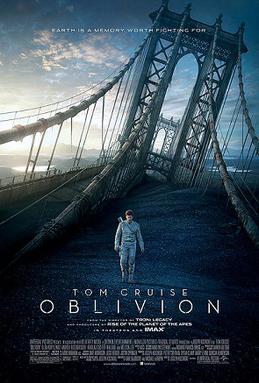
Long Story Short: Oblivion is a pretty typical modern sci-fi action film, with the twists and turns that those movies have incorporated as standard practice. However, whereas many of those films shoot for the stars and go straight into the mud, Oblivion holds it together for an entertaining event: a veteran, skilled action star (Cruise); noteworthy visual effects; restrained, effective suspense; and a plot that holds together long enough to keep the suspension of disbelief.
Well, I didn't plan to have another extended delay between movie reviews, but that's what happened. I hope to see another film from April, 42 (the Jackie Robinson film), sometime, and I had hoped to catch this one sooner than I did. But as of this week, the "official" summer movie season has begun, so the reviews should start to come in a lot more regularly (starting with Iron Man 3). About this film: when I saw the trailer for it in the theater, I was quite intrigued: an interesting sci-fi premise, plus Tom Cruise whom I enjoy as an actor. Unless it got terrible reviews, I was determined to go see this - a warm up to the summer blockbusters. Oblivion was directed by Joseph Kosinski (only his second feature film!) and stars Tom Cruise, Morgan Freeman, and Olga Kurylenko.
Some sixty years in the future, technicians Jack (Cruise) and Victoria (Riseborough) are alone on a very different Earth from the one we know. This one has been devastated by the destruction of the moon, and the alien invasion that followed. What remains of humanity has fled to a space colony near Jupiter, and Jack and Victoria have the mission of overseeing the salvage of whatever resources can be collected from Earth. Jack goes down to the surface, spotted with half-buried artifacts from bridges to skyscrapers, each day to maintain the fleet of drones that look for remaining aliens, while Victoria keeps watch from their base high in the atmosphere.
With just two weeks until their mission is complete, Jack and Victoria begin to feel a strain in their relationship. Victoria is eager for more human company, but Jack feels a growing pull toward his home planet and isn't so sure he wants to leave. Meanwhile, mysterious beings watch silently from the shadows...
Obviously, there isn't a huge cast in this sci-fi dystopia, but there are some interesting characters. Tom Cruise as Jack is the lead, as Cruise typically is. There really isn't much about Jack that distinguishes him from a generic male lead: he is physically and mentally very capable, and somewhat rebellious. But Cruise has gotten so good at this type of role that he makes Jack likable and fun to watch, even if unoriginal. Riseborough as Victoria actually gets a more interesting, though far smaller, part. She loves Jack to the point of obsession, and is fiercely protective of the relationship. You can tell she winces internally each time Jack resists their orders, fearing that they will be separated. Neither Olga Kurylenko's acting nor her character, Julia, add much to the film. I won't give any details about her since it would spoil things, but even in a raft of similar small parts for women in action films, this is a poor one. I was hoping that Morgan Freeman would have a larger role than he did, but even still, it's good to see him. I do hope he gets more to do in the next of his film's that I see.
Like last year's Looper, the makers of Oblivion seemingly took pains to really remake Earth for the purposes of the film. The most obvious effect is in the sweeping landscapes through which Jack flies his nifty hovercraft. Nature has reclaimed almost all of the land; Jack lands in the stadium where the last Super Bowl was played, and it looks like the Colosseum. there's also the Empire State Building, Washington Monument, bridges, and so on. The massive emptiness also helps to heighten the suspense, showing how exposed and alone Jack is as he does his work. The action in the first half or so is used cautiously and effectively, although in the second half it turns more to sci-fi cliche. One thing I liked about a lot of last year's films was that, although they were not intended as comedies, many had great humor; Oblivion really doesn't have much at all - but at least it doesn't make horrible or cheesy attempts at it, either.
***
Oblivion makes the fourth "good but not great" film I've seen in a row in 2013 (although the year began with the excellent Zero Dark Thirty). I'm perfectly happy that I went to the theater to see it as it's an entertaining film and one meant to be seen on a big screen. Tom Cruise is an eminently watchable actor, in my opinion, even in a role without distinction. The film has great visuals, as well as some nice suspense and an interesting plot. The writers were smart: they knew the audience would be able to see twist(s) of some kind coming even if they tried to hide it, so they downplayed the importance of keeping them secret and unveiled them in a mostly reasonable fashion. Oblivion is also nicely paced. On the down side, the writer and director seemed to grab for more sci-fi cliches for safety in the second half as events speed up and become larger in scope. What is an entirely personal story in the first half becomes a little confused as to its priorities in the second half, dragging even the best parts of the story down a little bit. Still, Oblivion is a very solid sci-fi action flick, where many in the genre start with good intentions and completely fall apart. You'll be able to tell by watching the trailers if you would like this, so if they interest you, I recommend you give it a try.
Score: ***** out of ***** (A+)
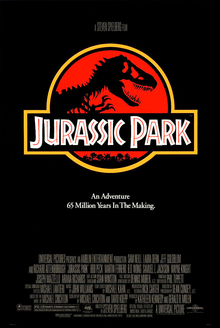
Long Story Short: Put simply, my favorite movie of all time. Twenty years ago, I was blown away by the wonder of dinosaurs brought to life; in the years since, that wonder has been supplemented by an admiration for the skill with which Spielberg balanced the story and pacing; the cast provided a believable human context; and especially John Williams lifted the whole thing to mythical status through music. If joy and wonder and adventure are things that appeal to you, go see this in the theater (again).
This summer, it will be 20 years (!) since Jurassic Park was first released in theaters. Universal has decided to rerelease this Spielberg hit, not just one of the biggest blockbusters of all time but a true landmark in film production. Since it's not a new release, I won't be including it in my year-end rankings (it also wouldn't be fair, since it would be #1). I must admit, I have not seen the 3D version yet (that's tonight!), but I have seen the film dozens of times and wanted to get a review out on the release weekend, which rarely happens. Jurassic Park, based on the 1990 novel by Michael Crichton, was directed by Steven Spielberg and stars Sam Neill, Laura Dern, and Jeff Goldblum.
On a remote island off the coast of Costa Rica, something amazing is happening that is soon to be revealed to the world. The leader of this venture, a wealthy CEO named Hammond (Attenborough), invites a few people to preview this attraction prior to unveiling it publicly, including a pair of weary, dusty paleontologists (Neill; Dern) brought in from the middle of a dig. Only when they arrive at the island do they discover why: Hammond and his company, InGen, have brought to life the things the things they have studied all their lives - things which have been dead for 65 million years and longer.
Before opening the world's most spectacular "biological preserve," Hammond hopes to convince these paleontologists, a lawyer (Ferrero) and a chaos theorist (Goldblum) of its safety. To do so, these guests are given the first "standard" tour of the park. Meanwhile, word of this island has gotten out to the main land, and the guests' stay takes a turn for the worse...
While the dinosaurs are the real stars of Jurassic Park, it's worth at least noting those characters with speaking roles - they aren't there just for dino dessert. Sam Neill as paleontologist Dr. Grant serves as the lead, and he performs well. The writers and Neill both understood the importance of restraining Dr. Grant - making him almost boring. Yet he's believable, a loner who gradually realizes the value of family; he evolves, just like the dinosaurs. Jeff Goldblum is in by far the most interesting role I've ever seen him as Ian Malcolm, providing both brain-teasing forboding as well as some truly great comic relief. Laura Dern doesn't have a huge part, but she is an underrated heroine here in displaying great courage, wit, and compassion as Dr. Grant's (only vaguely romantic) partner. The supporting roles are also well-cast: Attenborough as the idealistic but short-tempered Hammond; Ferrero as the slimy (and short-lived) lawyer; Wayne Knight as Nedry, the nerd in completely over his head. Even the kids, Lex and Tim, are not aggravating like so many child characters are in film; in fact, their presence is an essential ingredient in the film's tone and perspective.
What really matters, here, though, are the dinosaurs. And beyond any other strengths or weaknesses you might find in the film, Spielberg and his digital and animatronics team hit a grand slam. Not only are the dinosaurs incredibly realistic in appearance and behavior, they are also used to maximum effect by Spielberg, showing every ounce of his talent for grandiosity. Spielberg gives a truly terrifying preview - while showing very little - in the opening scene, and then when we finally see the first dino, it is an utter jaw-droppingly majestic moment (thanks in large part to the score, which I'll get to). Throughout the film, Spielberg continues this alternation between the terrifying and majestic, sometimes even combining the two, and he does so flawlessly, seamlessly. Without completely giving away the climax, I hope, Spielberg even turns my favorite dinosaur into the hero of the film.
An aspect of Jurassic Park that I must discuss, though I rarely do for other films, is the score. Done by John Williams, the ever-present musical force in Spielberg's films, this is my favorite score of all time and, for me, catapults the film from excellent adventure film to all-time great. The main theme is just perfect, a soaring melody that absolutely captures the wonder of the film - of the power of film in general. The score is literally a scene-stealer at times, and throughout Jurassic Park it serves to enhance the mood, whether it be forboding, silly, triumphant, terrifying, and so on. Bravo, Mr. Williams. Bravo.
***
I saw Jurassic Park in the theater, way back in 1993 as a six-year-old, and it was probably the first non-kids' movie I'd seen on the big screen. I was so obsessed with dinosaurs as a kid, I had to see this; and while it was certainly thrilling and tense, rather than give me nightmares it inspired my dreams and imagination. I think that everyone probably has a "perfect film": one that connects especially with their particular personality and symbolizes the best of what film has to offer them. That is Jurassic Park for me: the initial connection due to my love (primarily as a child, yes, but they still fascinate me) of dinosaurs, and, deeper than that, a feeling of awe for how full of wonder life is - that is, both our own lives and the unbelievable life all around us. More often than not, I shed a few tears as the helicopter flies off toward the setting sun at the end of the film, with John Williams' amazing theme carrying us all away. They really and truly don't make them like this anymore; do yourself a favor and go see Jurassic Park in the theater - especially if you didn't have the privilege to do so back in 1993.
Score: ***1/2 out of ***** (B-)
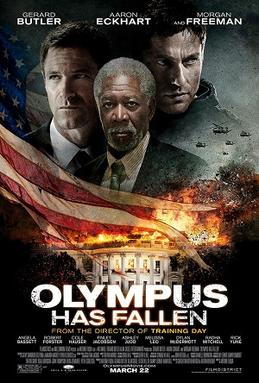
Long Story Short: At last, a fun, ambitious action film comes out with stars who aren't over the hill! Butler and Eckhart make for likeable protagonists, while a dash of Freeman adds (artificial) weight and the villain is quite timely. Olympus has its fair share of flaws throughout, but the taking of the White House itself is enough to get action fans to the theater, and once there they will enjoy a nice popcorn film.
While the weather is only now starting to look a little more like spring, the Hollywood schedule was undeterred by this and its spring lineup is well underway. A number of action films have already come out in 2013, most of which did not appeal to me (Bullet to the Head with Sylvester Stallone? Ugh), were critically trashed and even failed at the box office. However, it's been a little while since I've seen a straight up Die Hard-style action film, so when I heard about Olympus Has Fallen, I was interested. It got decent reviews (for the genre), had a neat premise, and star actors. The film was directed by Antoine Fuqua (Training Day) and stars Gerard Butler, Morgan Freeman, and Aaron Eckhart.
Olympus begins in a winter vacation spot with a regular family - that has a contingent of bodyguards. That's because this regular family is POTUS (Eckhart) and his wife and son; the bodyguards, particularly Banning (Butler), are like an extended family here. Unfortunately, a tragedy occurs and Banning, although he is not at fault, is removed from the Secret Service. A year and a half later, with Banning working at Treasury, a delegation from South Korea comes to visit the White House. During the visit, the appearance of a rogue aircraft triggers a well-choreographed, all-out assault on the White House, and the military is unable to arrive before these terrorists wipe out local defenses and infiltrate.
Fortunately, our hero Banning is still in DC and soon becomes, with the help of acting President Speaker Trumbull (Freeman), the nation's only hope to avert catastrophe.
As you might imagine, Olympus Has Fallen is not an actors' showcase. Nevertheless, Gerard Butler is well-cast as the hero of the film. His physical build makes him a believable butt-kicker, and he is able to switch nicely between silent, grim focus and warm, friendly guardian to POTUS's son. Butler's delivery of John McClane-esque humor isn't as effective, but he's certainly a guy you can root for. Aaron Eckhart is similarly well-cast as the President; really, both characters are split 60-40 between tough guy and family figure (that's Butler; it's 40-60 for Eckhart).
Morgan Freeman is once again the Voice of Authority - specifically, the Speaker of the House who becomes acting President with POTUS and the Vice out of action. Freeman is another puzzle piece but, maybe just because his role is smaller and simpler, it seemed like a paycheck role for him. Eckhart just seemed to be working harder, whereas Freeman rode the power of his mere presence. Filling out the rest, Dylan McDermott plays the nasty little snake with conviction; and Rick Yune, who reprises his role from the 2002 James Bond film, Die Another Day.
OK, OK, what really matters here? The action! Fortunately, Olympus Has Fallen succeeds overall in this aspect. The assault on the White House is especially good; the writers clearly put as much thought into this as they did the rest of the film combined. The level of tension in this extended scene rises at a great pace - not peaking too soon and numbing the audience to the rest of it. At times the violence is a bit gratuitous, but overall I think going for it with the "R" rating was the right choice (also freeing characters to use choice language when needed, but it's not overdone). After the opening assault, the action becomes more formulaic, but still entertaining. While Banning's mastery of White House security is more than a stretch, what you actually see on screen - the fights - show him as a really good but not immortal, Chuck Norris-like killing machine. There is virtually no humor here through the first half or so, and then the Die Hard-style banter begins between hero and villain - not nearly as effectively as its predecessor, unfortunately.
***
When I think about what score to give to a film, I balance a number of different things: overall quality, of course (writing, acting, plot, etc.), but also how much I personally enjoyed it, as well as expectations for the film to a degree - which includes genre. I ask myself, What were the goals of this film (or at least, what was I hoping to get out of it)? For Olympus Has Fallen, the answer to that was basically tense, fun action and likable, not too cliched characters (and perhaps some nice explosions). Well, Olympus succeeded pretty well on those counts. I lowered its grade for having too many extraneous little threads that go nowhere, a dull villain (post-assault), and the suspensions of belief sometimes being a bit too much (characters being extraordinarily stupid as often as unrealistically prescient). Still, the frame of the film is solid, with some real highlights not only in the action (again, the taking of the White House) but also in some of the personal scenes. It's pretty simple: if you like action films, I recommend it. If you don't like action films, well, this one isn't going to change your mind.
Score: ***1/2 out of ***** (B)
Long Story Short: Director Sam Raimi takes on the famous wizard in Oz the Great and Powerful, the first expected blockbuster of the year. Despite having the structure of a standard family film, Oz manages to entertain both young and old with an engaged cast and clever ideas throughout. And even with a limited range of outcomes, Oz manages some surprises (particularly Franco's "hero").
I promise you, I will improve my current average of seeing a movie per month! That task is looking to become easier as the studios begin to release more films that interest me. The first, and perhaps biggest, film in what has become the new "spring blockbuster season" is Oz the Great and Powerful. It has been many years since I've seen The Wizard of Oz, so long that I barely remember it - but the trailer and commercials for this just piqued my interest for some reason. Well, with a talented director, interesting cast, and decent score on Rotten Tomatoes (~60% at time of release), I decided to give it a try, just hoping for an entertaining time at the theater. Oz the Great and Powerful was directed by Sam Raimi (Spider-Man films) and stars James Franco, Michelle Williams, Mila Kunis and Rachel Weisz.
The film begins in Kansas in 1905 (thanks, Wikipedia), the picture framed in a black-and-white square. Oscar Diggs (Franco) is a magician with a traveling circus, whose most effective tricks seem to be wooing his young female assistants and bossing his male assistant around. After a tough performance, Oscar gets even worse news: a rather large man is angry at him for flirting with his girlfriend. Oscar flees in a hot air balloon, but gets swept up in a tornado and finds himself flung into Oz (along with normal aspect ratio and full color). He finds fantastic, unearthly life forms in addition to a young witch, Theodora (Kunis). Upon meeting Oscar, the witch is excited that he is the prophesied Wizard of Oz, come to save the realm from the Wicked Witch.
Along the way to the Emerald City, Oz works his charm on Theodora and picks up a flying monkey companion named Finley (Braff). All are merry at the news in the City, but Theodora's sister, Evanora (Weisz), informs him that he must first defeat the Wicked Witch before he can become King of Oz (and enjoy the massive room full of gold left for him). Oz sets off on the task with Finley, but as you might imagine, not all turns out as planned in the effort to rid the realm of its evil-doer.
A rather eclectic cast was assembled for Oz, and for the most part it works quite well. James Franco is the lead as Oz, of course. I am not really a fan of Franco, but that works out here: I think he seems arrogant, falsely charming, and conniving - and that's basically what Oz is. Of course, Franco/Oz aren't all bad, but it's pretty intriguing to have a non-traditional hero in this fairly traditional story. Glinda the Good Witch is played by Michelle Williams, who looks absolutely stunning but is certainly no damsel in distress. Williams pulls off a combination of great gentleness of character without coming off as naive, and her mental and emotional resolve is a great example for young viewers. Rachel Weisz is also great as the witch Evanora, a calculating, cool-headed power broker in the Emerald City.
Unfortunately, not only is Mila Kunis miscast as Theodora the witch, her part is also the worst-written aspect of the film. Her character just sticks out like a sore thumb from the time she appears, and Kunis makes it worse by overacting. Oz also has two nonhuman companions: the already-mentioned Finley, as well as China Girl. Finley, as voiced by Scrubs' Zach Braff, is a fun character who is great for young audiences and perfectly tolerable for adults, too. China Girl, voiced by Joey King, is also good, displaying a great attitude early on; unfortunately, both characters are mostly forgotten in the last third or so of the film.
The narrative structure in Oz the Great and Powerful is standard, what you'd expect from a family-based film, but it has enough interesting aspects within that structure to keep adults' attention, too. Oz could easily have been made as a film to show off "look how cool the land of Oz looks, updated from the 1939 classic!" - but fortunately, Raimi keeps this to a minimum and instead focuses on the characters throughout. Perhaps most impressively, Oz manages to keep its self distinct from the classic film. For example, each may have similar openings with the main characters swept away by tornado, but it doesn't come off as contrived. The ending, which has certain results that are expected, achieves its ends cleverly. There is also, fortunately, none of the cynical or self-aware humor of some recent family films, and Franco is actually pretty funny. As a last note, the soundtrack didn't really stand out to me at all.
***
Ultimately, the fun, creative, even memorable moments in Oz the Great and Powerful outweigh its flaws to result in a good family film. First, I'll elaborate more on the downside: the script is not all that good. The worst part, as I mentioned, is pretty much everything to do with Theodora; in addition, the film has a pretty substantial running length for a family film (2 hrs, 7 minutes) and so it drags at times (this is also the fault of the editors, of course). I realize that this is a family fantasy film, but some of the plot devices also come off as a little too convenient. On the other hand, there is a lot to like here, too. The entire cast seemed to enjoy it (no "phoned-in" performances), Franco is very well-cast as Oz, and Williams and Weisz are great as polar opposite witches. The focus on character even comes down to the climax: instead of using yet another effects-heavy battle of armies, the good guys are forced to outwit rather than outmuscle their foes. Perhaps Wizard of Oz fanatics will find more to complain about than I did, but if you are just looking for a fun time that offers more clever twists than the usual family film, check it out.
Score: ***1/2 out of ***** (B)
*At the bottom of this review, I am posting my hopes for Oscar winners.*
Long Story Short: Steven Soderbergh, director of films as varied as Contagion and Magic Mike, continues to surprise with his choice of a pharmacological thriller. He gets some high-quality acting from the main characters, played by Rooney Mara and Jude Law, and gives his audience an intriguing take on depression, and the hows and whys of the ways society deals with it. I personally was disappointed at the abrupt change in direction in the last part of the film, but the ideas and acting are enough for me to recommend it overall.
What I thought might turn out to be another usual prolonged film drought in winter was unexpectedly interrupted last week. I had not even known this film existed until I checked Rotten Tomatoes to see what the current options were. Side note: Identity Thief seemed to have promise, but it was lambasted so badly by pretty much every critic that I didn't want to waste my money on it (I was pleased not to have wasted money on last year's The Dictator). When I checked what Side Effects was all about, I was intrigued: an interesting plot concept, a good cast, a notable director, and a very impressive critical reception (86% currently on RT). Sounds good to me! Side Effects was directed by Steven Soderbergh and stars Rooney Mara, Jude Law, Channing Tatum, and Catherine Zeta-Jones.
After an opening of mysterious, foreshadowing scenes that take place later in the film, Side Effects introduces Emily (Mara), a young woman awaiting the release of her husband, Martin (Tatum), from prison for insider trading. There is great joy upon his return home, yet Martin finds that his wife has nevertheless relapsed into depression. It gets so bad that coming home from work, Emily tries to kill herself. In the hospital, she meets psychiatrist Jonathan (Law) and begs him to let her go home again. He agrees, but insists that she see him for therapy on a regular basis. Jonathan prescribes several anti-depressants to Emily but they don't work.
However, a new drug called Ablixa, recommended to Jonathan by Emily's previous psychiatrist (Zeta-Jones), works wonders on her despite having the side effect of occasional sleepwalking. It goes downhill from there, though, as the side effect causes Emily to commit a serious crime. As Jonathan defends Emily, he faces scrutiny as well for his methods.
One of Side Effects' draws for me, as I mentioned, was the cast, and it does not disappoint. Rooney Mara as Emily is the film's lead. I haven't seen Mara in much else, but she certainly shows her talent here. Especially early in the film, when there's not a lot of dialogue, Mara does a great job of communicating her inner turmoil with body language alone: the way she stares, the way she moves. Really strong lead performance. Jude Law as Jonathan is her primary co-star, and he similarly puts on a great show. He displays the intelligence and compassion that mark the exemplars of his field in psychiatry, yet also, when things go bad, the condescension of "you don't understand people like I do" while at the same time being blindsided by political and financial motives.
The film's supporting roles are filled by Channing Tatum as husband Martin, and Catherine Zeta-Jones as Emily's old psychiatrist, Victoria. Tatum's part is fairly small, but he lends the role a gentle personality, sympathetic partner, and doesn't take attention away from the key player, Mara. Zeta-Jones also does a good job with her part, a rather stiff, unlikeable psychiatrist. Her role gets a little out of hand later in the film, but it's mostly the script's fault, not hers.
With Side Effects, I was looking forward to a dramatic take on a serious issue in the country: increased use of pharmaceuticals, and, specifically, anti-depressants. I was quite pleased by this aspect of the film. While it really focuses primarily on the main characters Emily and Jonathan, these characters are well-positioned (and well-acted) to represent the issue in a very believable way, with surprisingly few cliches. The aspects involved include everything from the sufferer's (Mara) lonely moments when you can see her thinking about giving up on life, to the struggles of medical personnel (Law) in deciding the best way to handle a situation, to the patient-removed motives of big pharma and consulting companies. The final shot of the film is one of the most effective I have seen in a while: an immense mental facility placed right beside a busy urban highway, representing, to me, how there is this massive issue in society that we encounter each day without necessarily realizing it. Humor was sparse, but that's the way it should be here. The score was quite good, particularly at the beginning of the film - as with watching Mara's body language, it's easier to pay attention to the music when there isn't constant dialogue.
***
"OK," you're probably thinking. "Based on all you've said, why didn't you rate this higher than a B?" To put it in as general terms as I can, I didn't like the direction the film took in the second half. If you don't want a slightly more spoiler-y explanation, STOP READING UNTIL YOU SEE ALL CAPS AGAIN! What appears in the first half of the film to be a completely plausible sequence of events and mixture of personalities, suddenly evolves into a conspiracy that keeps growing and growing. Admittedly, without said conspiratorial turn, poor Jonathan would have been left out to dry. As it is, Jonathan's character gets too smart, and Zeta-Jones too zany for my tastes, not to mention the details of the "real" story. OK YOU CAN START READING AGAIN. In my opinion, Side Effects would have been significantly better with a decent wrap-up to the events of the first half/two-thirds of the film, which would have resulted in a snappy ninety-minute or so running time. Instead, it dragged on and lost focus on the riveting depiction of a believable story in trying to change directions too quickly and too drastically. Still, you may (and clearly many critics do) disagree with me there. Despite my disappointment, I certainly recommend it for the first half and the great acting, though a theater trip isn't essential.
2013 Oscars
My hopes for the best picture, director, and acting categories:
Best Picture
Amour (haven't seen it)
Argo
Beasts of the Southern Wild (haven't seen it)
Django Unchained
Les Miserables (haven't seen it)
Life of Pi
Lincoln
Silver Linings Playbook
Zero Dark Thirty
My pick: While Life of Pi is my favorite of the year, I know it doesn't have a chance, so I am pulling for Lincoln. The frontrunner seems to be Argo; while that's a very good film, and a worthy winner in a weaker year, this is a strong year and Life of Pi, Lincoln, and Zero Dark Thirty are each at least a cut or two above it, in my opinion.
Best Director
Michael Haneke (Amour)
Ang Lee (Life of Pi)
David O. Russell (Silver Linings Playbook)
Steven Spielberg (Lincoln)
Benh Zeitlin (Beasts of the Southern Wild)
My pick: In this category, Ang Lee stands out as the obvious choice for his remarkable job making such a difficult film. I guess my second choice would be Ben Affleck for Argo, for the way he balanced great tense parts with light, funny ones - oh, wait, that's right, he got snubbed. Then I guess I'd have to pick Kathryn Bigelow, for making bold narrative choices and leaving the audience to decide tough issues for themselves - what's that? She's not nominated, either? Academy Awards FAIL.
Best Actor
Bradley Cooper (Silver Linings Playbook)
Daniel Day-Lewis (Lincoln)
Hugh Jackman (Les Miserables)
Joaquin Phoenix (The Master)
Denzel Washington (Flight)
My pick: Daniel Day-Lincoln, of course. I did hear great things about Phoenix in The Master, so I want to check that out some time. Denzel also gave the best performance I've seen from him in years, if not ever, and he would be a deserving winner in most other years.
Best Actress
Jessica Chastain (Zero Dark Thirty)
Jennifer Lawrence (Silver Linings Playbook)
Emmanuelle Riva (Amour)
Quvenzhane Wallis (Beasts of the Southern Wild)
Naomi Watts (The Impossible)
My pick: I've heard fantastic reviews of each of these performances, but only seen two of them. I would give the nod to Chastain over Lawrence in the more challenging role (plus I think Lawrence is just a little overrated). Great choices here, including both the youngest and oldest nominees in Oscar history!
Best Supporting Actor
Alan Arkin (Argo)
Robert de Niro (Silver Linings Playbook)
Philip Seymour Hoffman (The Master)
Tommy Lee Jones (Lincoln)
Christoph Waltz (Django Unchained)
My pick: Hoffman is the only one I haven't seen. Of the other four, this category is about as easy as Best Actor: Tommy Lee Jones, no question. The other three did great jobs, no doubt - but Jones hit a grand slam in Lincoln.
Best Supporting Actress
Amy Adams (The Master)
Sally Field (Lincoln)
Anne Hathaway (Les Miserables)
Helent Hunt (The Sessions)
Jacki Weaver (Silver Linings Playbook)
My pick: As with Best Actress, I'm afraid I've only seen two of the nominees' films. And one of them, Weaver, I honestly don't know why she was nominated. It wasn't bad, just... very small and inconsequential to the film. Sally Field, however, would be a perfectly deserving winner, in my opinion. That makes three actor picks from Lincoln. Interestingly, The Master has nominees in three categories, too, yet it doesn't have a best picture or best director nomination...