Sunday, March 27, 2022

The Batman


Score:  B+

Directed by Matt Reeves
Starring Robert Pattinson, Zoe Kravitz, Jeffrey Wright, Paul Dano
Running time: 176 minutes
Rated PG-13

Long Story Short:  The Batman brings the famed hero back to theaters, this time with Robert Pattinson wearing the cape and Matt Reeves (Planet of the Apes reboot) behind the camera.  It's darker than any of its predecessors, both in aesthetics - a grimy but impressive Gotham - and a view of the city's "legitimate" leaders being as bad as the super villains.  It's well produced, along with a strong cast and good action scenes - but it's also too long, with accompanying problems of pacing.  Still, it's well worth a trip to the theaters to catch this blockbuster.


Gotham City has fallen into decay despite the best efforts of slain philantropist Thomas Wayne; his son, Bruce (Pattinson), tries to hold the darkness at bay via his vigilante identity as the Batman.  A new criminal has begun targeting high-profile individuals and leaves messages for the Batman.  While he is helped by officer James Gordon (Wright), Batman seems to have more respect from the deranged new threat than from Gotham's suspicious authorities.  As Batman tracks Gotham's latest menace, he learns more about the city itself - as well as his own family history - that leads him to question his mission.

The Batman is a strong return for DC's most famous superhero, entertaining and well-produced in many ways; however, it's held back by a gratuitous running time.  The character is more familiar to movie audiences than any other superhero, with the exception of Spider-Man, and so - as it was with the MCU's Spidey - it's crucial to strongly distinguish a new version.  Certain elements, notably the character's origins, are almost too well-known, and so The Batman wisely spends little time on this.  It does, though, have an interesting new (to me) twist on Wayne family history.  Gotham itself is practically a main character - more later - and its look and feel is one of the best parts of the movie: a dark, grimy place, yet teeming with life and energy, too.  Batman's new costume is suitably cool, along with gadgets both new and familiar; the Batmobile is the most down-to-earth and raw version yet, rumbling loudly with untamed power.  Speaking of sound, Batman gets another great theme and soundtrack, this time from Michael Giacchino.  The setting is very important for Batman, and this movie creates a good one.

The plot works nicely on two levels: one, it forces Batman into detective mode (a distinctive yet often overlooked ability), and two, it digs into the history and corrupt power structure of Gotham.  Bruce Wayne is in fact one of the least interesting characters here, which is both a knock on the writing and praise for the supporting cast.  Batman's two main allies, officer (not yet commissioner) Gordon and Selina (aka Catwoman, though they never call her that), are a lot of fun and played very well by Wright and Kravitz.  The bad guys - there are plenty of them - are also intriguing, especially an unrecognizable Colin Farrell as the Penguin, here a mere mob lieutenant.  There is plenty of action to go with the mental games, and even though most of it is shot in darkness, it is surprisingly coherent and watchable.  It's also satisfying; Batman is no super kung-fu master here, relying more on brute force and some trusty armor, taking almost as much punishment as he dishes out.  An opening melee with a gang sets the tone, but we also get some flashier sets, like an exhilarating nighttime highway chase.

The main problem with The Batman is that it is significantly too long, however.  It's not that there are any obviously superfluous parts, but the overall pacing is consistently slow, meaning each scene is pretty long - even those that shouldn't be.  Part of the reason for this goes, I think, to another weakness: reliance on the structure of the genre's gold standard, The Dark Knight.  The Riddler's crimes (if not his motives) are quite close to the Joker's; of course, there's no way that this new villain can measure up to Ledger's legendary performance, so this is a losing battle.  I won't enumerate them all, but there are plenty of other striking resemblances, to Batman Begins as well.  While The Batman visually and sonically creates a great, distinctive new world for its hero, the structure of events and even many details are a little too familiar.  Trying to measure up to its impressive predecessors, it hits all the "necessary" beats but a little more urgency would have helped.

***

The Batman is the best movie of the (still-young) year I've seen so far, and a good and worthy addition to the franchise.  I waffled between a "B+" and an "A-" for way too long on this movie - and I still may go  back on it later.  It's one of those movies that has so much good in it, it feels wrong to give it less than an "A-" - yet it has significant enough flaws in it that it also shouldn't get the same grade as other movies at that level.  Still, I'd much rather see that kind of film than what I'd call the *shrug* movie - which doesn't make much of an argument for OR against itself.  While there are disposable scenes I'll want to skip through on repeat viewings, there are about as many that I'll eagerly look forward to seeing again.  Give me more like this - though, maybe not so long, please.


* By https://www.the-numbers.com/images/movies/opusdata/Batman-The-(2021).jpg, Fair use, https://en.wikipedia.org/w/index.php?curid=69028880

Saturday, March 26, 2022

2020-21 On Your Left Film Years-In-Review

2020-21 On Your Left Film Year-in-Review

It feels like more than two years since I last wrote a year-in-review post, but then, more has happened in those two years than usually does in five, ten, or even twenty "normal" years.  I count myself as blessed to have made it through those two years with my life, health, and livelihood; movies seem like a small thing in comparison.  But I remain passionate about movies, and I was excited to return - cautiously - to theaters in 2021.  I'm therefore also happy to bring back this annual blog post, this year with a small modification: I am including the few films I got to see in 2020 before the pandemic (or those I saw at home in lockdown, by streaming).  I saw a somewhat different mix of movies than usual, though if anything, I'm surprised at how close it came to "normal", all things considered.

If it ain't broke (and I don't think it is), then I'm not fixing it, so the structure of this post will look the same as in years past:
  • Top 10 films of the year!
  • Most underrated/overrated films
  • Most surprising/disappointing films
  • Worst film of the year
  • List of other films I saw in theaters (with links to my reviews)
  • Films I saw on streaming
Please check out my companion post here, which is more like my Oscar-style awards.  There were definitely some great films released in the last two years, so I hope you'll check some of these out!


Top 10 Films of 2020-21

10. Eternals (Directed by Chloe Zhao; starring Gemma Chan, Richard Madden, Salma Hayek, Angelina Jolie, Kumail Nanjiani, et. al.)

Marvel had a lot of movies pent up during the pandemic, releasing four new ones in theaters in 2021.  Eternals made a modest (by Marvel standards) $165 million in North America, and a shockingly low 47% critical approval rating.  I mostly attribute this to it being quite a bit different than other MCU movies; ironic, since critics whine constantly that they are so tired of Marvel movies.  It isn't perfect, but Oscar-winning director Zhao makes the central, crucial decision to focus on the individual struggles and relations in this tale of epic mythology.  The performances are all solid and the action is good; but the primary draws are its fresh perspective and detour from recent Marvel plotting.

9. Palm Springs (Directed by Max Barbakow; starring Andy Samberg, Cristin Milioti, J.K. Simmons)

I did not see many new comedies during the last two years, continuing a trend, but this one - released only on streaming, appropriately - was one of the best.  Another spin on the Groundhog Day premise, Palm Springs finds its strengths in a surface tone of droll desolation that eventually gives way to true emotional connection with the two stars, played by Samberg and Milioti.  Samberg, who I enjoyed on the great Brooklyn Nine-Nine, is a perfect match for his part and Milioti is every bit as good or better.  The pacing and total running time (90 minutes) are well crafted for the premise, starting with plenty of silly and quirky hijinks before transitioning to more poignant material.  A nice little gem.

8. Tie: West Side Story (Directed by Steven Spielberg) and In the Heights (Directed by Jon M. Chu)

Despite superficial similarities - these are both musicals set in New York City featuring Hispanic communities - there are many more differences, from the plots to the tones, not least because they premiered on stages fifty years apart.  But I can't help but think of them together and the impression that they are both very good, but not great, musical adaptations.  Each has its strengths; In the Heights's plot naturally has more resonance for a modern audience and its characters are unique, far from any stereotypes though the acting can be uneven.  West Side Story has a powerful, timeless story and some terrific performances (especially DeBose and Faist) despite some characters now feeling a little too familiar.  What they both have are tremendous music and dance choreography, guaranteed to entertain any audience.  Try them both - and see how the genre has evolved.

7. The Lost Daughter (Directed by Maggie Gylenhaal; starring Olivia Coleman, Jessie Buckley, Dakota Johnson, Ed Harris)

While The Lost Daughter does not have much of a plot to it and it's quite heavy, it's also much better than another movie that shares those characteristics, The Power of the Dog.  Olivia Colman does phenomenal work as the lonely vacationer Leda; she is prickly and rough around the edges, but combined with flashbacks, we get such a clear, searing picture of this character that both the positive and the negative are understandable.  Its rumination on the joys and challenges, to understate it, of modern mother- and womanhood are powerful; and its accompanying point about the failures of men is fresher and more subtle than the one made in the previously mentioned Oscar nominee.  Not a cheerful film, but an important, compelling, and very well-made one.

6. Dune (Directed by Denis Villeneuve; starring Timothy Chalamee, Rebecca Ferguson, Oscar Isaac, Jason Momoa, Stellan Skarsgard)

Villeneuve is one of my favorite contemporary directors (Prisoners, Sicario, Arrival, etc.), so when I saw that he was filming an adaptation of this sci-fi classic, I made sure to read the book first to prepare.  The story definitely benefits from the filmmaker's strengths of creating unique, eerie atmospheres directly from the sounds and images before you even get to the characters or plot.  Zimmer doesn't quite get to the sonic heights of Villeneuve's late collaborator Johannsson but it's still strong, as are the effects; and the desert world is appropriately spellbinding.  If anything, I wish that it was even more subtle though I can see how that could have confused those who haven't read the novel; and there's a bit too much action (Momoa, really? Sigh).  But I'm nitpicking; if you're not a superhero fan, this is the 2021 blockbuster to see.

5. Downhill (Directed by Nat Faxon and Jim Rash; starring Will Ferrell, Julia Louis-Dreyfus)

The terrible critical score (37% on RT) almost dissuaded me from seeing this, but Ferrell and Louis-Dreyfus was a combo too good to pass up - and I'm glad I didn't.  The dry humor is something Louis-Dreyfus has shown a knack for in Veep, but Downhill takes it to another level entirely.  It's really a dramedy split equally between the drama and comedy, and arguably even more effective at the former.  One Ferrell-Louis-Dreyfus confrontation, with their friends as tortured observers, is both one of the most painfully awkward and simply amazing scenes I've seen in years.  It takes a little while for the film to warm up - or, more accurately, chill down - or maybe the audience just needs time to acclimate to the style.  Either way, prepare yourself for a new experience - and a treat.

4. Black Widow (Directed by Cate Shortland; starring Scarlett Johansson, Florence Pugh, Rachel Weisz, David Harbour)

Although the wait for her own movie was too long and it doesn't advance the overall MCU narrative, Black Widow is essential for any superhero fan and a fun blockbuster for anyone else.  Despite already knowing the fates of certain characters and related plots, the movie provides a great balance of a rich exploration of Johansson's character, Natasha, as well as introducing fun new characters for this background and development.  Johansson - who's always done rock-solid work - is joined by the impressive trio of Pugh, Weisz, and Harbour.  The action is largely grounded, a nice change from other recent MCU films, but as intense and hard-hitting as Winter Soldier or Civil War.  As a bonus, it's surprisingly funny, too.  Not as flashy as its kin, but very, very few are better made than Black Widow.

3. The Trial of the Chicago 7 (Directed by Aaron Sorkin; starring Eddie Redmayne, Sacha Baron Cohen, Joseph Gordon-Levitt, Mark Rylance, et. al.)

I wish I could have seen this in theaters; but, I'm also happy that anyone can see it now on Netflix.  I am a huge Aaron Sorkin fan, particularly his writing (The West Wing, The Social Network, etc.) but he's now even a great director, too, first with Molly's Game and now this.  Similar to his previous film, Trial illustrates a historic moment by placing the main action in the aftermath.  There are only a handful of flashbacks to the Democratic Convention riots of 1968, but they are very powerfully done, a mixture of sparse but potent writing, crescendoing tension, and a perfectly complementary soundtrack.  The ensemble cast is just phenomenal, getting the absolute best out of such a wide range of actors who are both fun and funny as hell, especially in the trial scenes.  And Sorkin also brings out emotion from history like past titans Lincoln and Selma; there's a cathartic good-guys-vs.-bad-guys element, but it ends with a poignant reminder that the true stakes of the story involved those who never got a say in their own fate.

2. Spider-Man: No Way Home (Directed by Jon Watts; starring Tom Holland, Zendaya, Benedict Cumberbatch, Alfred Molina, et. al.)

Endgame marked the conclusion of not just a 20-film, 11-year overarching plot in the MCU, but also the Avengers superhero team as we knew it.  Of course, the MCU continues, but there has been a significant vacuum where the "Originals" - Iron Man, Captain America, and Thor - once led.  No Way Home doesn't try to replace them, exactly, but it takes up the MCU's emotional helm and, seemingly, has given it a definite new narrative direction, too.  Parker and his friends and family are given their most potent drama in this, their third outing, including a unique, breathtaking final sacrifice.  We also get teased the, well, infinite future possibilities of the multiverse.  Oh, and speaking of multiverse, No Way Home shatters the fourth (fifth?) wall by incorporating characters (played by the original actors) from other Spidey movies - those starring Tobey Maguire and Andrew Garfield.  Balancing all of this required an Avengers-level high wire act and everyone from the director, to writers, to cast, to crew pulled it off beautifully.  A triumph that confidently announces the MCU will not be fading away any time soon.

1. Belfast (Directed by Kenneth Branagh; starring Jude Hill, Caitriona Balfe, Jamie Dornan, Judi Dench, Ciaran Hinds)

Belfast was the first Oscar hopeful (now a confirmed multi-nominee) I'd seen in a movie theater in almost two years, and it was so good that it seemed to me a sign of hope for the future.  I knew, in addition to the awards buzz, that it was based on acclaimed director Branagh's upbringing during the Troubles - beyond that, I was simply hungry for a really good drama.  Fortunately, it succeeded spectacularly.  Despite a slim (but ideal) running time of just over ninety minutes, Belfast packs in so much, and with remarkable depth.  
The acting is great across the board, from the charming young Hill to desperate yet strong parents Balfe and Dornan, to wise, steady, loving grandparents in Dench and Hinds.  The black-and-white images are beautiful and set the tone in a variety of ways, not just as a signifier of history/memory; and the jazzy soundtrack is unexpected yet wonderful.  But it is the film's amazing ability to hold two seemingly opposing sides of life in equal and complementary, not contradictory, ways that sets Belfast apart as the greatest film of 2020-21.  The despair and danger of social upheaval and violence, plus personal family turmoil on the one hand; yet the joy and innocence of childhood and the strength of family bonds on the other.  This is illustrated by the film's two best scenes: its first, as the Troubles strike suddenly like lightning on a little neighborhood; and one of the last, when the family enjoys a sparkling dance.  This is a must-see movie.

Honorable Mentions:  No Time To Die, The Green Knight


Most Overrated Film of the Year:  The Power of the Dog (runner-up: The Suicide Squad)
Despite the pandemic, there were still a lot of new superhero movies to watch in the last two years.  One of my least favorite, yet one that got among the best critical receptions, was The Suicide Squad.  It's not bad, and has plenty of fun parts.  But Deadpool, by being such an exemplar of the crude, ultra-violent yet funny superhero movie, kind of spoiled the game for everyone else.  The Suicide Squad doesn't really add anything new to this subgenre, and both tries too hard while going generic on the finale.
To me, by far the most overrated film of the year is The Power of the Dog, one of the favorites for Best Picture at the Oscars.  I'll begin by stating that a good part of this may be simple personal taste; I recognize that in terms of filmmaking mechanics, there are well-done elements, particularly Benedict Cumberbatch's acting.  But my overwhelming reaction to the movie was: WTF?  Just unrelentingly dark and dismal, or at least bleak (life on a Montana ranch? No thanks).  The plot, such as it is, is uninteresting and left unexplained in many important ways (to be Mysterious or Artsy?).  The themes, on homosexuality and toxic masculinity, are tiresomely done (and much, much better done in so many other movies), IMO.  It's two hours, but feels more like three.  No, thanks.

Most Underrated Film of the Year:  Downhill (runner-up: Eternals)
I've already described these two in my top 10 films of the year, but I want to emphasize that these two - very different - movies were very underrated.  Something that draws them together is that they are also quite different than what I expected - in Eternals' case, different from other MCU movies, and for Downhill, a different style of humor and level of drama than I expected.  I admit that often when a movie turns out much differently than I expected, it negatively affects how I react to it, so this may be a big reason for the critical (and box office) results.  But I apparently kept an open mind while watching these, and was rewarded for it.  They're both definitely much more worth a try than you might expect.

Most Disappointing Film of the Year:  Wonder Woman 2 (runner-up: N/A)
My disappointment in the Wonder Woman sequel is two-fold: its release and its quality.  Originally to be released in theaters in June 2020, that became impossible, of course, due to the pandemic.  The studio lost patience after moving back its release date several times and decided to just dump it on HBO Max for Christmas 2020.  In contrast, Marvel patiently held Black Widow, originally scheduled for May 2020, and released it in theaters in July 2021.  I wish DC had done the same.
On the other hand, Wonder Woman 2 turned out to be mostly a dud.  Particularly disappointing since the first, in 2017, was so good, the sequel was just bizarre.  The villain and his plot were ridiculous; it might have been funny in a blatant parody movie, but this was not (I think?).  My opinion might be at least a little better if I'd seen it in a theater - where it was meant to be seen - but I'm having trouble remembering much that was great about this movie, except for some Kristen Wiig fun here and there.

Most Surprisingly Good Film of the Year:  The Lovebirds (runner-up: Birds of Prey)
Margot Robbie's Harley Quinn appears in both the most overrated, and the most surprisingly good, movies of the year.  She doesn't really get much to do in The Suicide Squad; an interesting "rebound" with a bad guy boss unfortunately goes off the tracks quickly and into mindless violence.  But she gets quite a bit of interesting character exploration in Birds of Prey, featuring her but also a few other heroines in a cool, feminist superhero film.  Plus, the action is less bloody, more creative, and much more fun in this one.
I saw several "meh" Netflix original films over the last two years (see below), but The Lovebirds was better than just a way to pass the time.  Starring the talented duo of Issa Rae and Kumail Nanjiani, it's a rom-com action film, up to date in both modern relationship dynamics and also, though more subtly, racial context.  It's got a great opening hook, very good writing, and even a nice finale, which this and similar genres usually fail.

Worst Film of the Year:  Army of the Dead; The Power of the Dog
I didn't see any truly bad movies in the last two years, fortunately.  Well, at least, I didn't bother sitting through to the end.  I started to watch Melissa McCarthy's Netflix comedy Thunder Force but stopped; she is often able to lift up otherwise poor films, but not this time.  I did finish Army of the Dead, since it was at least fairly entertaining throughout and held some hope for improvement or at least something interesting (neither of which really happened).  Dave Bautista is fun (if a bit much at times) in a supporting role in Guardians of the Galaxy; as a movie's lead, not so much.
The most unpleasant film I saw, by a pretty wide margin, was, again, The Power of the Dog.  Part of me wants to see it again in case I missed something or was just in the wrong mood.  But it was just so off-putting to me, I don't think I can go through it again.

Other Films I Saw in Theaters in 2020-21

Streaming Movies
  • Don't Look Up! (B+): I did like this movie, and was particularly happy to see a climate change allegory get so much attention (hopefully giving some sort of boost to real-world efforts to combat the greatest crisis of our time).  I think its Best Picture nomination is a stretch, but DiCaprio and Lawrence are fun to watch and writer/director McKay (The Big Short, Vice) is clever.
  • The Mitchells vs. The Machines (B+): This is among the stronger non-Pixar animated films I've seen recently... but still, non-Pixar.  I like the average-family-in-a-robot-apocalypse hijinks, but there are some missed opportunities.  It's well-made and worth it for families and adults alike, but not a must-see.
  • Borat 2 (B): Definitely not for everyone, but you already knew that.  This was a lot better than I was expecting, as some of Cohen's non-Borat movies have been pretty awful.  His co-star Maria Bakalova is excellent, every bit as good as Cohen, and the raunchy humor is smart and funny enough to excuse itself (IMO).
  • 6 Underground (B): Yes, it's directed by Michael Bay; yes, it has a lot of explosions.  But this is a lot better than a Transformers movie.  Ryan Reynolds leads a good cast and there is plenty of good action and humor.  One of the best throwaway streaming "blockbusters" I've seen; I'd watch it again.
  • The Old Guard (B): This one is more ambitious and serious, which both hurt and helped it.  Theron is great in a neat, if not completely original premise of ancient, immortal (rather, constantly reincarnated) warriors.  Not one for the squeamish.
  • Moxie (B-): I honestly don't remember this one too well; I mostly watched it because of Amy Poehler.  It has good intentions and is more creative than the typical coming-of-age movie, but the execution is too often mediocre.
  • Space Jam 2 (C+): I actually did see this in the theater - I saw the original in theaters, too, when I was a 10-year-old Michael Jordan super fan.  It's fun, though LeBron is, probably unsurprisingly, not the most compelling lead.  The technical effects are impressive, and a halftime gag made me laugh out loud.

Well, those were the years 2020 and 2021 for me in theaters and at home with the movies.  I hope you've already seen - or will be inspired to go out and see - some of my recommendations.  Take care until next time!


* https://deadline.com/2022/01/belfast-script-kenneth-branagh-read-the-screenplay-1234918538/

2020-21 On Your Left Film Awards


2020-21 On Your Left Film Awards

It's been two years since I last wrote my annual film year-in-review posts.  I am very happy to return to this tradition, and I also look back on the last two crazy, time-warped, tumultuous year and am thankful for the opportunity to do so.  The pandemic changed a lot of things, for the entire world and myself included, but it did not diminish my passion for seeing movies in a theater.  Streaming is good, too - especially when going to the theater is impossible - but it simply cannot replace the cinematic experience.

Here are my Oscar-like awards for both 2020 and 2021 movies.  I'm keeping the same "rules" that I had in 2019 and earlier:

  1. Only films released widely in 2020 and 2021 are eligible (this is getting murkier each year, so another way to put it: whichever year it came out in my theater - or streaming only - is the year I'm sticking it, so certain films often have to "wait" a year), and 
  2. Only films that I've actually seen are eligible.
I'll note the nominees in the Oscar-equivalent categories, for comparison.  Please check out my other annual movie post, which includes my top 10 of the year and other miscellaneous awards (over/underrated, etc.)!

Winners in bold
Runners-up underlined


Best Actress
Caitriona Balfe (Belfast)
Olivia Colman (The Lost Daughter)
Rebecca Ferguson (Dune)
Julia Louis-Dreyfus (Downhill)
Margot Robbie (Birds of Prey)

Oscar nominees not listed: Jessica Chastain (The Eyes of Tammy Faye), Penelope Cruz (Parallel Mothers), Nicole Kidman (Being the Ricardos), Kristen Stewart (Spencer) - didn't see films

Quite an array of movie genres are represented by these actresses, who all did exceptional work, in very different styles.  I'd give an honorable mention, too, to Cristin Milioti, starring in the sci-fi comedy Palm Springs with Andy Samberg.  Margot Robbie has played the role of the psychopath anti-heroine Harley Quinn in two different movies in this span, with Birds of Prey being both the superior film and showcase for Robbie.  She somehow seems to fully inhabit Harley's deranged mind, one of the most entertaining characters in the crowded genre.  Caitriona Balfe is probably the unsung MVP of Belfast, a strong and loving woman holding her family together in the midst of social and personal strife; Balfe plays her both raw and under control, capable and also vulnerable.  Rebecca Ferguson's Lady Jessica is similarly at the center of the story of Dune, and she expresses herself remarkably well, mostly through body language, in a stoic role.

Julia Louis-Dreyfus got a great role in Downhill, one of the most underrated films, let alone comedies, in years.  It feels so real - partly from the writing, but at least as much from her performance - shifting from driest hilarity to squirm-in-your seat tense and awkward.  Colman, who has impressed in period pieces like The Favourite and The Crown, shows that she is just as skilled in a modern, ordinary role in The Lost Daughter.  She gets to do a little of everything, from the silent to the showy, sympathetic but sometimes repugnant.  Both of these actresses bring greatness to their films.


Best Actor
Benedict Cumberbatch (The Power of the Dog)
Leonardo DiCaprio (Don't Look Up)
Jamie Dornan (Belfast)
Will Ferrell (Downhill)
Dev Patel (The Green Knight)

Oscar nominees not listed: Javier Bardem (Being the Ricardos), Andrew Garfield (Tick, Tick... Boom!), Will Smith (King Richard), Denzel Washington (The Tragedy of Macbeth) - didn't see the films

Honestly, it was a bit of a down year in this category; good performances, but nothing truly great.  I give Tom Holland an honorable nod for his third Spider-Man movie; he seems almost custom-made for the role but he also clearly gives it his best, and his heart, throughout.  As he did previously in Stranger than Fiction, Ferrell proved again that he has true dramatic acting chops in Downhill - though he's still funny, too, of course.  DiCaprio has been great in just about everything I've seen him in in the last ten years; this is a good, fun one (especially the accent), but the movie around him is just not as good.  Dev Patel is in almost all of The Green Knight - but he's not even the title character! - and does a good enough job being realistically bamboozled by the odd events to allow the audience to suspend its disbelief.

Benedict Cumberbatch shows great intensity in The Power of the Dog - but it's much different from the kind of intellectual, anti-social kind from The Imitation Game and Sherlock.  It's too bad the movie itself is a confusing, pointless load of hooey, but his character commands attention from beginning to end.  I'm sorry, Jamie Dornan, your performance isn't the stuff of great winners I've seen in years past.  But it's still very good, a restrained role that still provides much of the tension - in plot and emotion - in Belfast.  Fortunately, he gets to let loose in a final, out-of-nowhere sing-and-dance number that is truly joyful.


Best Supporting Actress
Jessie Buckley (The Lost Daughter)
Ariana DeBose (West Side Story)
Judi Dench (Belfast)
Maria Bakalova (Borat 2)
Florence Pugh (Black Widow)

Oscar nominees not listed: Kirsten Dunst (The Power of the Dog) - eligible but chose not to nominate; Aunjanue Ellis (King Richard) - didn't see the film

Like their lead counterparts, the supporting female actors this year produced fantastic performances.  I give an honorable mention to Jennifer Lawrence, who I hadn't seen for quite some time, going toe-to-toe with DiCaprio in Don't Look Up.  Borat 2 rises to the level of a good comedy on the strength of Maria Bakalova's performance, a "relative" of Borat's who is just as outrageous but even better at needling our society's shortcomings.  Judi Dench is a great presence in Belfast, even as she also fits into her modest matriarch role.  And Florence Pugh continues on a tear since I first saw her in theaters; now she's also part of Hollywood's biggest family, the Marvel Cinematic Universe.  She is great as both a hardened assassin and awkward yet loving sister in Black Widow.

Jessie Buckley more than held up her end of the bargain as the younger version of Colman's Leda in The Lost Daughter.  She has the advantage of many more passionate moments, from parental frustration to hidden lust, but she still connects all the dots to the primary, older version.  Ariana DeBose is the virtuoso performer of the year, serving as the best part of the West Side Story remake.  She has personality and character nuance to spare, with some of the movie's most powerful moments - and to top it off, she is also the most sensational performer, knocking my socks off with "America".


Best Supporting Actor
Dean-Charles Chapman (1917)
Sacha Baron Cohen (The Trial of the Chicago 7)
Mike Faist (West Side Story)
Ciaran Hinds (Belfast)
Tony Leung (Shang-Chi and the Legend of the Ten Rings)

Oscar nominees not listed: Troy Kotsur (CODA), J.K. Simmons (Being the Ricardos) - didn't see the films; Jesse Plemons (The Power of the Dog), Kodi Smit-McPhee (The Power of the Dog) - eligible but chose not to nominate

There is quite a variety of performances among the best of the supporting actors in 2020 and 2021.  Dean-Charles Chapman brought much-needed humanity, and even humor, to the intimate war epic 1917.  Ciaran Hinds was a perfect partner for Judi Dench in Belfast, as Buddy's wise and gentle grandfather.  Tony Leung was both one of the better parts of Shang-Chi and among Marvel's best villains to date; both charismatic and menacing, he was easily the biggest presence on the screen.

Mike Faist, while not as overtly brilliant as his co-star Ariana DeBose, brought an important emotional intensity to West Side Story.  While the love story failed to produce as many sparks as it should, Faist ensured that the Sharks vs. Jets confrontations were tense and also tragic.  Sacha Baron Cohen, as Abby Elliott, rose above them all in The Trial of the Chicago 7.  Best known as the silly, over-the-top (and vulgar) Borat, Cohen displayed very impressive control and nuance, a strong accent and body language.  And he was, of course, hilarious.  The film boasts easily the most fun ensemble of 2020-21 - from Mark Rylance and Jeremy Piven to Joseph Gordon-Levitt and many others - but Cohen stands out among them.


Best Director
Kenneth Branaugh (Belfast)
Nat Faxon and Jim Rash (Downhill)
Maggie Gyllenhaal (The Lost Daughter)
Denis Villeneuve (Dune)
Jon Watts (Spider-Man: No Way Home)

Oscar nominees not listed: Ryusuke Hamaguchi (Drive My Car) - didn't see the film; Jane Campion (The Power of the Dog), Steven Spielberg (West Side Story) - eligible but chose not to nominate; Paul Thomas Anderson (Licorice Pizza) - not eligible, released in 2022 (in my theater)

I don't know the filmmaking process, well, pretty much at all, so I judge the best directing to be a combination of the highest overall quality of the movie with the degree of difficulty - difficulty as it seems to me, at least.  Nat Faxon and Jim Rash would seem to have an easy job, making a comedy with Will Ferrell and Julia Louis-Dreyfus.  However, the humor was, for the most part, among the driest I've seen; and though it was indeed funny, it leaned more on its dramatic side, and successfully.  Maggie Gyllenhaal, a first-time director, gave her very plot-light film great tension and anticipation by focusing laserlike on its main character; the realism of all the little details gives the powerful dramatic components that much more weight.  Dune is very un-realistic, in a sense, taking place in a far-in-the-future sci-fi universe.  But Villeneuve succeeds most, in my opinion, in building that world, from the deserts to the cold technology, into a fully immersive experience.

This is not the first time - and hopefully won't be the last time - that I've give praise to a Marvel superhero movie director.  Similar to the Avengers films, in particular, this Spider-Man sequel, directed again by Jon Watts, has the high degree of difficulty challenge of handling a large cast; this one even more so, actually.  Kenneth Branagh did the best work of all this year, in a film that is semi-autobiographical.  He may have indulged in details of his own childhood but if so, they only serve to heighten the connection we feel to the main characters, young Buddy and his family.  There is plenty of turmoil, from both the Troubles and the family's domestic concerns, but it's not a heavy film.  What shines through is the innocence of childhood and the will to keep going even in the most difficult of days.  Everything is well balanced and executed, and I choose to give Branagh the lion's share of credit for that.


Best Screenplay
Jesse Armstrong, Nat Faxon, Jim Rash (Downhill)
Kenneth Branagh (Belfast)
Maggie Gyllenhaal (The Lost Daughter)
Andy Siara (Palm Springs)
Aaron Sorkin (The Trial of the Chicago 7)

Best Visual Effects
Dune
Eternals
Godzilla vs. King Kong
Shang-Chi and the Legend of the Ten Rings
Spider-Man: No Way Home


* https://www.britannica.com/story/who-votes-for-the-academy-awards

Saturday, February 26, 2022

Death on the Nile


Score:  C+

Directed by Kenneth Branaugh
Starring Kenneth Branaugh, Gal Gadot, Armie Hammer, Emma Mackey, et. al.
Running time: 127 minutes
Rated PG-13

Long Story Short:  Kenneth Branaugh follows up his hit adaptation of Murder on the Orient Express with another Agatha Christie story led by detective Poirot.  If you've seen Murder, you'll be familiar with the basic structure/mystery setup, and the large cast of bold characters, but it simply doesn't work as well this time.  Mostly, in my opinion, that's because of a darker tone with little - by character or plot - to attach your sympathies to.  See it if you want a change of pace, but it's not for everyone.


Famed detective Hercule Poirot (Branaugh) is enjoying a vacation in Egypt when he runs into an old friend, Bouc (Bateman).  Bouc is part of a group that is celebrating a couple's honeymoon - Linnet (Gadot) and Simon (Hammer).  The group is shadowed, however, by an unwelcome presence, Jackie (Macky), who seems intent on spoiling the couple's fun.  Linnet, Simon, Poirot and the rest board a cruise ship to sail down the Nile, and hopefully escape Jackie.  However, Jackie was not the only troublemaker; in the confines of the ship, old resentments and entanglements come to the surface.  After a shocking murder, Poirot is on the case, racing to find the culprit before they can escape - or kill again.

Death on the Nile, a sequel to Murder on the Orient Express, has about the same structure and style as its predecessor but fares worse in many ways, particularly due to its strikingly dark tone.  Based on another of Agatha Christie's Poirot mysteries, it has her classic whodunit story template which is fleshed out by the eccentric detective and a colorful cast of suspects.  In Murder, Branaugh - as lead actor and director - established Poirot as both an entertaining and interesting protagonist, and the film focused on him.  Unfortunately, Nile takes Poirot for granted; sure, there are some fun bits sprinkled in, whether fussing over dessert or digging into an interrogation.  But he's mostly just a spectator - one who at least should have had some more biting commentary on his mostly unworthy companions.  The murder mystery itself is also worse - not necessarily in the mechanics, but more in the tone.  Where Murder at least offered a sympathetic rationale for its crime, built up to throughout the story, Nile's is based entirely on greed and cruelty with quite a bit of collateral on top.

The dark nature of the crime contrasts oddly with both the setting and the main plot.  Nile features much more spectacular environments and vistas than the cold, cramped (but effective) train of Murder, but it's all an illusion of wonder; in fact, much of the CGI is noticeably shoddily done.  Then there is the honeymoon that serves as the backbone, which should in theory be a pure, happy celebration.  But the couple's history ruined - at least for me - any joy, since Linnet and Simon both left prior engagements to be with each other; Hammer's involvement, particularly in this role, is also unfortunate.  There aren't many characters to like outside the couple, either, except for Linnet's old classmate Rosalie (Wright) and her jazz singer aunt, Salome (Okonedo).  The performances are fine, but it's hard to get attached to anyone.  I'm focusing on the negative, but I can't help but compare it to its kin, the superior Murder on the Orient Express.  Nile has its share of enjoyable moments, but when I think about what it could have been in the context of Murder, there is clear disappointment.

***

When Murder came out, I was happy to go see it; fewer and fewer dramas, let alone mysteries, like it are found in Hollywood today.  It wasn't a classic but it was solid, so I was also interested to see this sequel.  Well, it's not just the blockbusters that can fall prey to disappointing comparisons with the original.  To be honest, my rating might be overly affected by my distaste for the dark tone and reaction to the particulars of the plot.  So, others may find Nile more equivalent in quality to Murder than I did.  It was not for me, though.  Murders don't have to be all bad, right?  Go ahead and try this in the theater if you're a big mystery/Christie fan, but waiting to see it at home (or not at all) is just fine, too.


* By http://www.impawards.com/2022/death_on_the_nile_ver3.html, Fair use, https://en.wikipedia.org/w/index.php?curid=61933419

Saturday, February 19, 2022

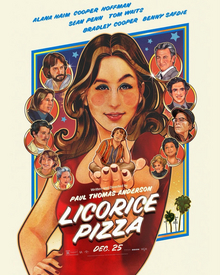
Licorice Pizza


Score:  C+

Directed by Paul Thomas Anderson
Starring Alana Haim, Cooper Hoffman, Bradley Cooper
Running time: 133 minutes
Rated R

Long Story Short:  Licorice Pizza is a coming-of-age period drama starring two debuting actors by the popular director Paul Thomas Anderson.  After a glimmer of possibility to start, the movie unfortunately becomes a disaster.  Alana Haim does great work and is the main (almost the only) draw.  Her character and relationship development is cast aside in favor of random, poorly-conceived side tracks, one after another.  Oh, and a host of bad men, from the annoying to the criminal.  Skip.


Gary (Hoffman), a fifteen-year-old child actor, falls in love at first sight with school photographer, Alana (Haim).  Ten years his senior, Alana is exasperated but, feeling listless in her own life, takes some comfort in his attention and the two strike up a friendship.  The bond takes them on a wild ride through 1970s California as Alana and Gary dabble in each other's interests, from acting to business to politics.  Many obstacles are thrown in their path, but Alana and Gary do their best to make it through, individually and together.

Licorice Pizza is not a good movie; it contains a fair number of sparks of good ideas - which, if it had fully pursued a few, could have worked - but instead it's one big mess.  At its core, this is a coming-of-age film - with way too much else going on - that is intended as a "prestige" picture by one of today's most lauded directors, Paul Thomas Anderson.  I'll start with what is worth seeing, since that will be quicker.  Alana Haim, a musician, is very impressive in her acting debut, and, largely thanks to the performance, her character is the most interesting part of the film by far.  A young adult, she has a close-knit family yet little sense of personal direction when the film begins, and you want to see where she'll go.  The relationship with Gary also starts off well, an extended dialogue during the opening scene establishing their characters and odd, age-mismatched dynamic.  There are some interesting period elements, including overall strong production design, a great soundtrack (for classic rock fans), and a direct impact on the story from the oil embargo.  There is also precisely one fun scene, involving the oil embargo and driving on empty.

Sadly, it doesn't take long for the promise of Alana's interesting character and her relationship with Gary to get lost and, by the end, essentially ruined.  The film simply and inexplicably loses interest and focus on those core elements - and not in service of some interesting plot that guides the rest of the movie.  Rather, it turns to a series of spontaneous, illogical and/or poorly explained events that have little connection other than forcing our main characters to tumble around in them like a washing machine until the finale dumps them out, soggy and hard to recognize, in a quick conclusion.  Alana survives these without getting completely lost, but Gary becomes less and less believable as a teenager, and more and more of a jerk (a theme on males I'll return to).  He becomes much more interested in himself - or maybe, the audience just begins to see that more clearly - and Alana simply a trophy for him to "win".  And these bizarre, poorly conceived/executed developments result in a movie that is way too long; ninety minutes would have been plenty.  There are too many utterly pointless scenes, making you feel the drag, yet other important parts get rushed through.

Finally, a theme (intentional?) of the film I found notable is male failure and sin, from standard patriarchy to blatant misogyny.  Maybe I am sensitive to this idea after seeing The Lost Daughter, which had similar themes.  But to me, it sure seemed that poor Alana was surrounded by a terrible collection of males, whether minor or major figures in her life.  It ranges from her peers (or close to it) - not just Gary's narcissism, but another potential boyfriend's thoughtlessness - to leaders, the supposedly genial yet racist owner of a restaurant and, in a significant role, a gay mayoral candidate who uses Alana as a prop potential love interest while tormenting his true lover.  Worst are the star cameos, Sean Penn and Bradley Cooper, whose presence and showy roles are a big part of giving the Prestige Picture appearance.  Both of their characters are sexual predators, or close enough that it makes little difference.  Their roles are also among the most incidental in a film full of them.  The male critique in The Lost Daughter is interesting, thoughtful, and useful; in Licorice Pizza, it's just sickening and too often seems presented as gratuitous entertainment itself.

***

I am flabbergasted by the critical acclaim that Licorice Pizza has received - not to mention its nomination for Best Picture, Director and Screenplay.  The only other film I've seen by Paul Thomas Anderson is There Will Be Blood, which is very good - certainly much, much better than this.  But if this qualifies as one of his best in critics' eyes, I'm not sure I want to see any of his others.  There are clearly elements in the film that had potential; as I wrote, the first part starts off quite well.  It is just so bizarre the direction it takes after that, almost as if in open defiance to what the sensible options could have been.  This is definitely the worst of the Best Picture nominees that I've seen from 2021.  I hope to see a few more, like The Power of the Dog, and get the taste of this one out of my mouth.  Awards season has more to offer - I strongly advise you look elsewhere!


* By http://www.impawards.com/2021/licorice_pizza_ver3.html, Fair use, https://en.wikipedia.org/w/index.php?curid=68829075

Saturday, January 29, 2022

The Lost Daughter


Score:  A-

Directed by Maggie Gyllenhaal
Starring Olivia Coleman, Jessie Buckley, Dakota Johnson, Ed Harris
Running time: 122 minutes
Rated R

Long Story Short:  The Lost Daughter is the film adaptation of a novel by Elena Ferrante about a middle-aged woman whose experiences as a young mother resurface during a rockier-than-expected vacation.  Olivia Coleman is fantastic as the lead; the opposite of bombastic, she is utterly convincing in a role that needed just that.  While the movie has little plot, it is a fascinating exploration of motherhood and much that affects it in the modern world.  Highly recommended.


Leda (Coleman) arrives on a Greek island hoping for a quiet, restful vacation, but soon finds the experience quite a bit less soothing than hoped for.  Her beachside accommodations leave something to be desired, including a genial but intrusive manager, Lyle (Harris).  Sunbathing and writing on the beach, where she spends most of her days, Leda's peace and quiet are interrupted by new guests, a large, young, rowdy family.  Mostly annoyed by them, Leda nevertheless is drawn to one young mother whose presence brings back powerful memories for her.  Despite seemingly huge differences, the women find a strange connection.

The Lost Daughter is a well-made, powerful character-driven drama led by excellent performances and an engrossing script.  Olivia Coleman is among the very top actors working today, and it's good that she plays the main character, Leda, because the film is focused on her like a laser.  Jessie Buckley, playing Leda as a young mother in a substantial number of flashbacks, is also great and gets the more passionate side of the character.  But Coleman, as usual, is just fantastic.  She truly inhabits the part, as a middle-aged professor on a solo vacation.  Early on, the film effectively sets a very realistic stage; as beautiful as the Greek setting is, Leda endures a number of mundane but realistic and acutely-observed annoyances, from rotten house fruit to getting her umbrella set up just right.  There is really only the thinnest of plots here, to give a little direction for the characters, but it's really those characters themselves that deserve all the attention.  The cinematography is also good but, again, somewhat lost as most of the attention (mine, at least) was thinking about the characters.  I think the pacing was also pretty good - for a two hour movie with little plot - but I also watched it in a few chunks at home, so seeing it straight through might be different.

The characters are the true draw in this film, as well as the themes that emerge from their realistic circumstances.  Leda may be the protagonist of the story, but a flawed one at that.  She is rather aloof and distant, often curtly rejecting friendly overtures from others at the beach; she also makes a mystifying choice halfway through that causes pain to the very people she starts to cling to.  Granted, I could also put myself in her exasperated shoes when young men keep rudely shattering her peace.  The family Leda observes shocks her with its combination of closeness and occasional generosity, along with chaos and occasional hostility.  No wonder that she is fascinated by Nina, the young mother, whose background seems so different to hers yet her daily life - raising a difficult young daughter - feels so familiar.  This is where the flashbacks come in, showing Leda's struggle to raise two daughters of her own while trying to build her own academic career.  There are some minor dramatic flourishes, but this is the central idea, to me: illustrating modern motherhood.  And while I am not a mother nor even married, it struck a cord with me.  Not about the mothers, who show great strength and love despite some failings, but anger at my own gender.  I know plenty of great fathers and husbands, but too often men fail to be true partners, particularly in sharing in the raising of their children - and this, to me, is the root of Leda and Nina's struggles and even trauma.  So, is this a cheerful film?  No, but it is a strong, captivating one, and has essential observations on the very nature of domestic relations.

***

The Lost Daughter is a leading awards candidate among 2021 films (Oscar nominations aren't out until February 8; why so late???), and I would definitely agree even if it isn't a "favorite" of mine.  I am conflicted about its release on Netflix.  On one side, it's great that this is available to such a wide audience (though I doubt all that many will actually see it).  And streaming in general offers a more realistic pathway for smaller films like this in the future.  But I am sure I would have been even more engrossed by this in a theater, and I really hope that most Oscar hopefuls will continue to get at least a brief wide release in theaters.  Anyway, to repeat, this is not a cheerful one but it is a great choice for anyone looking for a mature, realistic drama and one with a lot of interesting things to say about modern life.


* By http://www.impawards.com/2021/lost_daughter.html, Fair use, https://en.wikipedia.org/w/index.php?curid=68864633

Saturday, January 22, 2022

The 355


Score:  B

Directed by Simon Kinberg
Starring Jessica Chastain, Diane Kruger, Penelope Cruz, Lupita Nyong'o, Sebastian Stan
Running time: 124 minutes
Rated PG-13

Long Story Short:  The 355, featuring an all-female team of agents trying to stop a terrorist plot, hits both refreshing high, and disappointing low, notes.  The cast - with Chastain, Kruger, Nyong'o, and Cruz - has some of the best actors in Hollywood and they shine, particularly in the first part, to go with some great action.  But it falls apart in the second half, failing to realize the potential of the first.  Still, best to see this one in the theater - the good parts are worth it.


A team of Colombian commandos intervenes in what they believe is a high-level drug deal, but actually involves something unusual - and much more dangerous.  The agent who finds the object flees for his safety, but intelligence agencies all over the world pick up on this urgent incident.  The CIA sends a pair of agents, Mace (Chastain) and Nick (Stan) to retrieve the object, just as the German BND sends their best agent, Marie Schmidt (Kruger).  The flurry of competing parties leads to chaos, and the object goes missing again.  As more experts enter the mix, like tech guru Khadijah (Nyong'o), the chase intensifies - and the stakes grow, too.

The 355 is an entertaining action thriller built around an ensemble, but its shoddy second half lets down a very promising first half.  I was drawn to the all-female team premise here; no gimmick, the movie assembled a formidable group of some of today's best actors including one of my favorites, Jessica Chastain.  The entire film is pretty fast-paced, but the early parts still manage to do a good job introducing the characters who, thanks to both good writing and great performances, are distinct and interesting.  Chastain's character, Mace, has a somewhat familiar but unique (for Hollywood) relationship with her male partner, Nick; in just a few minutes, you get the sense of a complex, real woman.  Mace's friendship with Nyong'o's Khadijah is also neat, and she as well as Kruger's and Cruz's characters also get brief but fascinating back stories and personalities.  For the genre, the character work is light years ahead of its competitors, but it also does have plenty of gripping action.  There are several standout scenes in the first half - a chase through Paris featuring Mace and Marie; a shootout in a busy port; and a really well-shot, chaotic-yet-clear spy classic in a Moroccan market.  They are all both creative (even in an oversaturated genre) and realistic-seeming.  You also can practically feel the hard punches and wince at each gun shot.

Unfortunately, the film starts going downhill steadily around the midpoint.  There is a major "twist" - which, really, is pretty much to be expected in this kind of movie.  That there is a twist is not the problem, but the movie begins to focus more and more on the increasingly ludicrous plot at the expense of the characters, to my great chagrin.  The filmmakers seem to have thought the action in the first half wasn't big enough, so these grow, too, and move firmly from the somewhat plausible to generic blockbuster territory.  A final member of the team is added late, Fan Bingbing, in what is pretty clearly an attempt to draw as big a Chinese audience as possible.  Even this element could have been incorporated well - how to add an agent from a rival nation to what so far is "Team West" - but it just gets sucked in as part of the escalating plot and action, too.  Possibly my biggest disappointment is the way the film transforms Mace and Nick's relationship.  I'm not terribly surprised at what they do, but there were plenty of other, MUCH better choices.  The ending sets up for possible sequels, but considering The 355's critical and commercial reception, that seems unlikely to happen.  It's a shame; if the second half had just followed through on the promise of the first, I would gladly see more.

***

My first movie of 2022 (of films released in the calendar year, that is), I was hoping The 355 would follow in the footsteps of several other early-year movies I've seen that far surpassed their bewilderingly low reviews - Downhill, The Upside, etc.  I'm still glad that I went to the theater to see it, though, as there are parts better than anything most films can offer.  I'd prefer to see this kind of Jekyll and Hyde movie, in other words, than a consistently mediocre one.  What is it about this pattern - possibly the single most common one in Hollywood of at least the last ten years - that so many movies start very well, only to have a disappointing second half/ending?  Is it just me?  Or is Hollywood just good at starting ideas and not following through on them?  Here's one suggestion:  for the love of God, not every movie (especially action/adventure) has to just get bigger and bigger as it goes.  Well, at least this was an interesting start to the year in movies - I'm ready for more!


* By http://www.impawards.com/2021/three_five_five.html, Fair use, https://en.wikipedia.org/w/index.php?curid=65503879